Showing posts with label Vatican. Show all posts

Sunday, September 1, 2013

Pope announces world day of fasting, prayer for Syria


VATICAN CITY - Pope Francis has called for the world to unite on Saturday in a day of fasting and prayer for Syria and said "God and history" would judge anyone using chemical weapons.

"May the cry for peace enter the hearts of everyone," the pope told tens of thousands of pilgrims at his traditional weekly blessing in the Vatican on Sunday.

"I condemn with particular force the use of chemical weapons. I still have in my mind and heart the terrible images of the past days," he said.

"There is judgment from God and history on our actions that no one can escape," he said, in his first explicit reference to the chemical arms claims.

He urged the international community to make "every effort" to begin a process of dialogue in Syria.

The pope said he would lead the prayers with a five-hour vigil in St Peter's Square on Saturday, just two days before the US Congress meets to debate possible strikes by the United States on Syria.

The relatively rare call for a global day of fasting and prayer was similar to one made by late pope John Paul II following the September 11 attacks in 2001, Vatican expert Luigi Accattoli told AFP.

Although he did not apportion blame for the alleged chemical attack, the pope's reference to divine judgment was also similar to John Paul II's call for members of the Italian mafia to confess their crimes and repent, Accattoli said.

His exhortation "Never again to war!" echoed a famous speech made by another of his predecessors, Paul VI, at the United Nations during the Vietnam War.

The pope's call came as the United States, France and other countries were making plans for a limited armed response against Syrian President Bashar al-Assad's regime over its alleged use of chemical weapons.

The Vatican has repeatedly pushed for a negotiated solution to the conflict and has already criticised plans by global powers for an armed intervention.

It has been more cautious, however, than some Christian leaders in Syria and the region who have openly defended the current Syrian government seeing it as a guarantor of a multi-religious state.

Christian minorities are concerned about the rise of radical Islam in the region and point to the example of Iraq, where there has been an exodus of Christians faced with violence and discrimination.

"My heart is profoundly wounded in these days by what is happening in Syria and I am anxious about the prospect of dramatic developments," the pope said.

"War leads to more war, violence to more violence," he said, voicing hope that "a chain of commitment for peace will unite all women and men of good will."

"Never again to war!" the pope said in his emotional speech, echoing a call made by late pope Paul VI at the United Nations during the Vietnam War.

The pope said he extended his invitation to push for peace in Syria to all Christians and the faithful from other religions, as well as non-believers.

"With all my strength, I call on the warring parties to listen to the voice of their own consciences, not to close themselves in their own interests but to look on the other as a brother," he said.

Saturday's prayers in St Peter's Square will begin at 1700 GMT and end at 2200 GMT, he said.

Fasting in the Catholic tradition is not as strictly interpreted as in other denominations or faiths.

"Everyone interprets it how they want. It can mean not eating or not drinking or missing only some meals or some courses in a meal," Accattoli said.

He said there have been other days of fasting and prayer for peace in Catholic Church history but these are rarely linked to a specific conflict.

source: interaksyon.com

Wednesday, March 13, 2013

Argentinian Jesuit emerges as Pope Francis


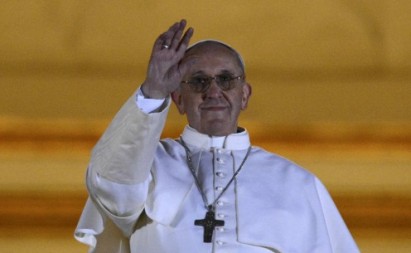
The Catholic Church has a new pope, a Jesuit, and the first pontiff from outside Europe: Argentina's erstwhile Cardinal Jorge Mario Bergoglio, who took as his papal name, "Francis".

White smoke billowed from the chimney of the Sistine Chapel at the Vatican on Wednesday evening (early Thursday, Manila time), signalling the election of the new pope to succeed the retired Pope Benedict XVI.

Bells pealed across Rome and in Christian cities around the world as the 1.2-billion-strong global Catholic community anticipated the introduction of their new leader.

Analaysts immediately read into Bergoglio's background: He is from South America, and his Jesuit background reportedly comes with a strong leaning for social justice.

Pope Francis was a darkhorse in selection of a new pope. Analysts believed the frontrunners for the papacy were from Europe - from where the majority of cardinals reside - but there was also a school of thought that reformists in the Church may go for a non-European, as most Catholics today do in fact come from the global south. Latin America, in particular, was believed to have had strong cardinal contenders, as the continent has more Catholics than any other region in the world.

Pope Benedict XVI, the former Cardinal Joseph Ratzinger, resigned suddenly last month, citing old age and failing health. Benedict's retirement threw the Catholic Church into unchartered territory, kicking off high anticipation for his successor in a modern era equipped as never before for global speculation.

Tens of thousands of pilgrims in St Peter's Square cheered and the bells of St Peter's Basilica rang out after the 115 cardinals meeting in a Vatican conclave signalled their momentous decision.

The 266th pope in the Catholic Church's 2,000-year history -- his identity is still a secret -- was due to emerge from the balcony of the basilica.

The crowd chanted "Habemus Papam!" ("We Have a Pope!") as they waited, waving flags from around the world.

Cardinals have been locked up behind the Vatican walls and cut off from the outside world since Tuesday, meeting in a sublime Renaissance chapel swept for recording devices and installed with scramblers to prevent any communication.

The smoke from the chimney was produced by burning the ballots and setting off smoke flares in two stoves specially installed in a corner of the chapel.

The decision came after five votes -- longer than for Benedict's succession to late pope John Paul II in 2005 which was decided in just four votes.

The historic election after Benedict's abrupt resignation last month was being followed around the world on live television as as well as through social media and smartphone apps -- this is the first ever tweeted conclave.

The Vatican has said the cardinal nominated to be the next pope will retire to a "Room of Tears" next to the Sistine Chapel to don his papal vestments and then pray in the Pauline Chapel before speaking on St Peter's Square.

Brazil's Odilo Scherer, Canada's Marc Ouellet and Italy's Angelo Scola -- all conservatives similar to Benedict in outlook but different in style -- were the three favourites but papal elections are notoriously difficult to predict.

Other possible candidates include Peter Turkson from Ghana, Luis Antonio Tagle from the Philippines and Timothy Dolan from the United States.

The odds have been stacked against cardinals from Africa and Asia -- two-thirds of the voter cardinals were from North America and Europe.

All the "Princes of the Church" were appointed by Benedict or his predecessor and ideological soulmate John Paul II.

But the names of cardinals from Latin America, where the largest number of the world's Catholics actually live, have also been in the rumour mill.

US President Barack Obama also chimed in on Wednesday, saying an American pope could be just as effective as any other, before quipping: "But the (US) conference of Catholic bishops... don't seem to be taking orders from me."

Benedict's eight-year papacy was riven by scandals and the new pope will face immediate challenges -- stamp his authority on the Vatican machinery and try to bring back a Catholic flock that is deserting churches across the West.

Benedict's style was often seen as too academic and he was never as popular as his predecessor. Many of the cardinals have called for a new pope who will be a good communicator, able to reach out particularly to young people.

Conclaves are usually only held after a pope dies and are sometimes decades apart -- the last one was in 2005, the one before that 1978. A popular Italian expression for things that happen very rarely is "at every death of a pope".

The 85-year-old Benedict broke with tradition, becoming the first pontiff to resign since the Middle Ages. He has said he will retire to a former nunnery inside the Vatican -- an unprecedented and delicate situation for the Church.

In one of his last acts as pope, he issued a decree allowing cardinals to bring forward the date of a conclave in cases of papal resignation -- a move seen by many as potentially setting a precedent for future ageing pontiffs.

The scandal of hushed-up sexual abuses of children by paedophile priests going back decades has also cast its shadow over the conclave.

The US group SNAP (Survivors Network of those Abused by Priests) called for over a dozen cardinals to be excluded from the conclave either for covering up abuses or making tactless remarks about the scandals.

The Vatican on Wednesday defended the cardinals and accused SNAP and other activists of showing "negative prejudices".

"None of us are surprised that they have tried to take advantage of these days to repeat their accusations and give them greater resonance," Lombardi said.

"These cardinals should be respected and have every right to be in the conclave," he said.

source: interaksyon.com

Wednesday, February 20, 2013

Pope may change conclave rules before abdication - Vatican


Pope Benedict may change Church rules governing the conclave where cardinals from around the world will meet next month to secretly elect his successor, the Vatican said on Wednesday.

Benedict was studying the possibility of making changes to laws established by his predecessor Pope John Paul before he abdicates on February 28, a spokesman said.

The changes may affect the timing of the start of the conclave. Current Church rules call for the conclave to start around March 15 but there have been indications that it could be held earlier if the rules are changed.

source: interaksyon.com