Showing posts with label Vatican City. Show all posts

Saturday, March 14, 2015

Pope Francis declares special Holy Year of mercy


VATICAN CITY -- Pope Francis announced on Friday the Roman Catholic Church will mark an extraordinary Holy Year, one of its most important events, in which faithful make pilgrimages to Rome and other religious sites around the world.

During the last Holy Year -- or Jubilee -- in 2000, millions of pilgrims came to Rome to take part in religious festivities throughout the year.

Making the surprise announcement in St. Peter's Basilica on the second anniversary of his election, Francis said the Holy Year will focus on the topic of mercy, one of the most important themes of his papacy.

It will start on December 8 of this year and end on November 20, 2016. This will be only the 29th Holy Year in the Church since the tradition started more than 700 years ago.

Holy Years normally take place every 25 years unless a pope decrees an extraordinary one to bring attention to a particular topic or need. The next one had been scheduled for 2025.

Francis, who says he wants his Church of 1.2 billion members to be more merciful and less rigid towards sinners, said the Jubilee would be an occasion for all members -- and the Church itself -- to rediscover the need to be forgiving and generous.

"The Church is the home that accepts everyone and refuses no one ... the greater the sin, the greater the love that the Church should show towards those who convert," he said.

During a Holy Year, one of the entrances to St. Peter's Basilica, which is known as the Holy Door and normally bricked up, is opened so pilgrims can pass through it. The Holy Doors of Rome's other basilicas are also opened.

According to the Vatican website, a Holy Year should be a time of reconciliation with adversaries and an occasion to promote solidarity, hope and justice in the world.

Faithful who make pilgrimages to religious sites or do good works during a Holy Year can receive indulgences, or the remission of punishment for sins, under certain conditions.

The Vatican said the official proclamation of the Holy Year, known as a papal bull, will be published next month. Cathedrals and other religious venues around the world are expected to be designated at national pilgrimage sites.

The last extraordinary Holy Year was called in 1983 by Pope John Paul II to mark the 1,950 years after the death of Jesus.

source: interaksyon.com

Thursday, January 1, 2015

Pope Francis criticizes corruption in Rome in New Year's Eve message


VATICAN CITY - In the traditional year-end Vespers prayers, Pope Francis denounced the corruption infecting the city of Rome.

Before thousands who were packed into Saint Peter's Basilica, he said: ”Without a doubt, the serious affairs of corruption in these recent days require serious heart-searching and action for a spiritual and moral rebirth of the city of Rome, as well as a commitment to build a more just and brotherly city, where the poor, the weak and the marginalized are at the center of our actions and daily activities."


He was referring to a police investigation that uncovered a network of connections between politicians and criminals in Rome.

The Pope delighted the masses after his homily when he paid a visit to the nativity in St. Peter's Square.

source: interaksyon.com

Wednesday, January 1, 2014

Pope calls for global solidarity in New Year blessing


VATICAN CITY - Pope Francis on Wednesday called for greater solidarity in the world in his first New Year blessing as pontiff in front of crowds of pilgrims on St Peter's Square.

"We all have a responsibility to act so that the world may be a community of brothers who respect each other, who accept their diversity and who take care of one another," the pope said on Catholic World Peace Day.

The first pope from Latin America said violence and injustice "cannot leave us indifferent or immobile" and said 2014 should bring "a real commitment to build a society with more justice and more solidarity".

"We have to stop on this road of violence! What is happening in the heart of man? In the heart of humanity? We have to stop!" the pope said.

Francis said he hoped that greater "fraternity" and a "cry for peace" from war-torn parts of the world would encourage more dialogue and "tear down walls that prevent enemies from seeing each other as brothers".

At a New Year mass in St Peter's Basilica earlier on Wednesday, Francis prayed in his homily for people "who hunger and thirst for justice and peace" in the world.

He also called on the faithful to show "strength, courage and hope" in the year to come, speaking in his homily in front of thousands of people in the church.

Francis was elected in March 2013 following his predecessor Benedict XVI's momentous resignation -- a first for the Catholic Church since the Middle Ages.

His down-to-earth style and commitment to reforming the Vatican have raised hopes in the Roman Catholic Church following a years of turmoil due to shocking child sex abuse scandals and growing secularization in the West.

The 77-year-old Francis has called for the Church to reach out more to the vulnerable and has said it should be a "poor Church for the poor" that is less "Vatican-centric" and gives more power to local bishops.

source: interaksyon.com

Monday, November 11, 2013

Vatican gives $150,000 in emergency aid to the Philippines


VATICAN CITY - The Vatican on Monday announced it is donating $150,000 (112,000 euro) in emergency aid to the Philippines after Super Typhoon Haiyan devastated entire communities and left more than 10,000 people feared dead.

"Following the Haiyan Typhoon... the Holy Father has decided to send a first contribution of 150,000 dollars to help the population", the Vatican said in a statement.

The aid "will be distributed through the local Church in the areas worst hit by the tragedy" and will be "used to support aid operations for displaced people," it added.

The donation is intended as "a concrete expression of the pontiff's spiritual closeness and paternal support for the people and territories devastated by the floods," it said.

Pope Francis led 60,000 people in Sunday prayers for the Philippines, urging the faithful to provide "concrete help" to the largely Roman Catholic country.

"I ask all of you to join me in prayer for the victims of Typhoon Haiyan / Yolanda especially those in the beloved islands of the Philippines", he tweeted on Saturday.

source: interaksyon.com

Tuesday, March 19, 2013

Pope Francis officially begins ministry in ceremony at St Peter's Square


VATICAN CITY (AP) - Pope Francis has officially begun his ministry as the 266th pope, receiving the ring symbolising the papacy and a wool stole symbolising his role as shepherd of his 1.2-billion strong flock.

A cardinal intoned the rite of inauguration at the start of Tuesday's Mass, saying "the Good Shepherd charged Peter to feed his lambs and his sheep; today you succeed him as the bishop of this church."

Later a half-dozen cardinals approached the Argentine-born pope to vow their obedience.

The installation occurred in sun-drenched St. Peter's Square before tens of thousands of people, princes, sheiks, rabbis and presidents.

source: straitstimes.com

Wednesday, March 13, 2013

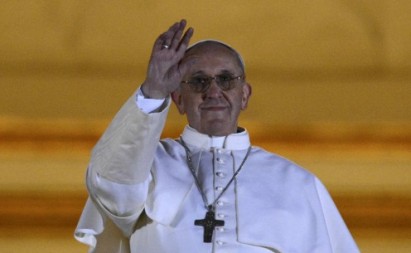
Argentinian Jesuit emerges as Pope Francis


The Catholic Church has a new pope, a Jesuit, and the first pontiff from outside Europe: Argentina's erstwhile Cardinal Jorge Mario Bergoglio, who took as his papal name, "Francis".

White smoke billowed from the chimney of the Sistine Chapel at the Vatican on Wednesday evening (early Thursday, Manila time), signalling the election of the new pope to succeed the retired Pope Benedict XVI.

Bells pealed across Rome and in Christian cities around the world as the 1.2-billion-strong global Catholic community anticipated the introduction of their new leader.

Analaysts immediately read into Bergoglio's background: He is from South America, and his Jesuit background reportedly comes with a strong leaning for social justice.

Pope Francis was a darkhorse in selection of a new pope. Analysts believed the frontrunners for the papacy were from Europe - from where the majority of cardinals reside - but there was also a school of thought that reformists in the Church may go for a non-European, as most Catholics today do in fact come from the global south. Latin America, in particular, was believed to have had strong cardinal contenders, as the continent has more Catholics than any other region in the world.

Pope Benedict XVI, the former Cardinal Joseph Ratzinger, resigned suddenly last month, citing old age and failing health. Benedict's retirement threw the Catholic Church into unchartered territory, kicking off high anticipation for his successor in a modern era equipped as never before for global speculation.

Tens of thousands of pilgrims in St Peter's Square cheered and the bells of St Peter's Basilica rang out after the 115 cardinals meeting in a Vatican conclave signalled their momentous decision.

The 266th pope in the Catholic Church's 2,000-year history -- his identity is still a secret -- was due to emerge from the balcony of the basilica.

The crowd chanted "Habemus Papam!" ("We Have a Pope!") as they waited, waving flags from around the world.

Cardinals have been locked up behind the Vatican walls and cut off from the outside world since Tuesday, meeting in a sublime Renaissance chapel swept for recording devices and installed with scramblers to prevent any communication.

The smoke from the chimney was produced by burning the ballots and setting off smoke flares in two stoves specially installed in a corner of the chapel.

The decision came after five votes -- longer than for Benedict's succession to late pope John Paul II in 2005 which was decided in just four votes.

The historic election after Benedict's abrupt resignation last month was being followed around the world on live television as as well as through social media and smartphone apps -- this is the first ever tweeted conclave.

The Vatican has said the cardinal nominated to be the next pope will retire to a "Room of Tears" next to the Sistine Chapel to don his papal vestments and then pray in the Pauline Chapel before speaking on St Peter's Square.

Brazil's Odilo Scherer, Canada's Marc Ouellet and Italy's Angelo Scola -- all conservatives similar to Benedict in outlook but different in style -- were the three favourites but papal elections are notoriously difficult to predict.

Other possible candidates include Peter Turkson from Ghana, Luis Antonio Tagle from the Philippines and Timothy Dolan from the United States.

The odds have been stacked against cardinals from Africa and Asia -- two-thirds of the voter cardinals were from North America and Europe.

All the "Princes of the Church" were appointed by Benedict or his predecessor and ideological soulmate John Paul II.

But the names of cardinals from Latin America, where the largest number of the world's Catholics actually live, have also been in the rumour mill.

US President Barack Obama also chimed in on Wednesday, saying an American pope could be just as effective as any other, before quipping: "But the (US) conference of Catholic bishops... don't seem to be taking orders from me."

Benedict's eight-year papacy was riven by scandals and the new pope will face immediate challenges -- stamp his authority on the Vatican machinery and try to bring back a Catholic flock that is deserting churches across the West.

Benedict's style was often seen as too academic and he was never as popular as his predecessor. Many of the cardinals have called for a new pope who will be a good communicator, able to reach out particularly to young people.

Conclaves are usually only held after a pope dies and are sometimes decades apart -- the last one was in 2005, the one before that 1978. A popular Italian expression for things that happen very rarely is "at every death of a pope".

The 85-year-old Benedict broke with tradition, becoming the first pontiff to resign since the Middle Ages. He has said he will retire to a former nunnery inside the Vatican -- an unprecedented and delicate situation for the Church.

In one of his last acts as pope, he issued a decree allowing cardinals to bring forward the date of a conclave in cases of papal resignation -- a move seen by many as potentially setting a precedent for future ageing pontiffs.

The scandal of hushed-up sexual abuses of children by paedophile priests going back decades has also cast its shadow over the conclave.

The US group SNAP (Survivors Network of those Abused by Priests) called for over a dozen cardinals to be excluded from the conclave either for covering up abuses or making tactless remarks about the scandals.

The Vatican on Wednesday defended the cardinals and accused SNAP and other activists of showing "negative prejudices".

"None of us are surprised that they have tried to take advantage of these days to repeat their accusations and give them greater resonance," Lombardi said.

"These cardinals should be respected and have every right to be in the conclave," he said.

source: interaksyon.com