Showing posts with label Smartphone Market. Show all posts

Sunday, February 3, 2019

Once red-hot smartphone market sees cooler trend


SAN FRANCISCO, United States — The smartphone market is down but not out, with high prices and other factors combining to chill what had previously been a red-hot sector.

Fresh surveys show global sales had their worst contraction ever in 2018, and the outlook for 2019 isn't much better.

Still, analysts don't see the sun setting any time soon on the smartphone era, seen as a must-have device for many people around the world.

"They don't have a viable replacement yet," independent Silicon Valley analyst Rob Enderle said of the smartphone.

"There is always the possibility to go to wearables or head-mounted displays, but none of those have emerged as a real threat."

Worldwide handset volumes declined 4.1 percent in 2018 to a total of 1.4 billion units shipped for the full year, according to research firm IDC, which sees a potential for further declines this year

Another market tracker, Gartner, said its research suggested some stabilization in the smartphone market at the end of last year, said analyst Werner Goertz.

"Mobile phones are here to stay," Goertz said, while suggesting that consumers may be waiting for some devices with new features.

"Foldable phones would represent a really nice disruptive feature," he said.

Analysts pointed out that other tech products such as personal computers have seen similar ebbs and flows.

"Markets will always have slow moments when companies have to spend more on marketing money to get people to go out and buy stuff," Enderle said.

He added that some consumers are holding off on replacing their devices amid price hikes for premium devices like Apple's iPhone.

Food or phone? 

During a recent earnings call, Apple chief executive Tim Cook agreed that people were holding onto their iPhones longer.

Cook contended that another reason for slower iPhone sales was that telecom carriers were cutting subsidies of handsets tied to service contracts, meaning customers were faced with paying full price of $1,000 or more for high-end models.

"People don't want to spend another thousand bucks to replace something that isn't broken," analyst Enderle maintained.

"In emerging markets you can't get people to pay a quarter of their monthly income for a phone; they are not giving up food for texting."

In an unusual move, Apple lowered prices in some emerging markets to offset the effects of a strong US dollar on local pocketbooks.

Cook said that in January, in some locations and for some products, Apple "absorbed part of the foreign currency move" to "get close or perhaps right on" prices in those respective markets a year ago.

"So yes, I do think that price is a factor," Cook said.

Market mess 

Nonetheless, the latest data suggests the days of red-hot smartphone growth are over and that sluggish growth or contraction is likely in many saturated markets.

Apple recently reported a rare drop in revenue in the fourth quarter South Korea's Samsung, the largest smartphone maker, reported a slump in fourth-quarter net profits, blaming a drop in demand for its key products.

"Globally the smartphone market is a mess right now," said IDC analyst Ryan Reith.

"Outside of a handful of high-growth markets like India, Indonesia, (South) Korea and Vietnam, we did not see a lot of positive activity in 2018."

Reith noted that along with consumers waiting longer to replace their phones and frustration around the high cost of premium devices, there was political and economic uncertainty.

The Chinese market, which accounts for roughly 30 percent of smartphone sales, was especially hard hit with a 10 percent drop, according to IDC's survey.

However, Chinese smartphone makers such as Huawei, Oppo, and Xiaomi defied the trend and ended the year with gains, according to Counterpoint Research.

This year, smartphone makers will likely entice customers to upgrade devices with innovations such as superfast 5G network connectivity and foldable screens , according to Counterpoint associate director Tarun Pathak.

Leading smartphone maker Samsung is expected to show off a smartphone with a foldable screen at an event here in February.

source: philstar.com

Wednesday, May 7, 2014

Global Wi-Fi shipments to hit 18 billion in the next 5 years — ABI Research


MANILA, Philippines -– Global shipment of Wi-Fi is expected to grow by leaps and bounds in the following years due largely to the growth of the smartphone market and increasing connectivity of various tools and gadgets.

From an expected 2.6 billion total this year, Wi-Fi shipment is expected to hit a cumulative 18 billion from 2015 to 2019 according to New York-based ABI Research. In the present market, ABI Research said that Wi-FI is “the most ubiquitous technology for Internet Access.”

“There will be a roughly even split in 2019 for Wi-Fi chipsets of different integration levels,” said ABI Research director Philip Solis in a press release. “Standalone, or discrete, Wi-Fi chipsets — increasingly targeting the ‘Internet of Things’ — will be the largest group, followed by integrated platforms with Wi-Fi targeting mobile devices, followed by Wi-Fi combo chipsets.”


The Internet of Things

The Internet of Things is the term used to the current trend where various objects or even animals are able to automatically transmit data over a network without any form of human control, such as a heart monitor implant or a tracking device on free-range animals for location and identification.

ABI Research added that concurrent with the industry’s growth, Wi-Fi protocols will also continue to evolve, though the dual-band network is poised to dominate the market.

“By the end of the forecast period, dual-band will comprise the vast majority of chipsets shipped among all the protocols. Dual-band had a strong start in 2013 by surpassing 100 million shipments in the smartphone space alone, which accounted for a sizable fraction of the total shipped that year,” ABI Research said.

Tri-band, however, will also see “a strong ramp” during the next five years according to ABI Research.

“The natural progression of Wi-Fi into more capable protocols and new use cases will have a profound effect on the Wi-Fi chipset industry. Smaller players will try to make a land grab for market share while the established players will defend their turf,” ABI Research said.

source: interaksyon.com

Wednesday, March 6, 2013

BlackBerry Z10 all set for March 19 availability in the Philippines


MANILA, Philippines — BlackBerry’s latest attempt at regaining the mobile crown will soon hit stores in Metro Manila, bearing a price tag of P29,990 and support for high-speed LTE mobile Internet, executives announced Wednesday.

The BlackBerry Z10, the first-ever smartphone to carry the Canadian phone maker’s revitalized BB10 operating system, will be available on March 19 through the top three telecom firms in the Philippines — Smart Communications, Sun Cellular, and Globe Telecom. LTE plans, however, have yet to be disclosed by the telcos.

For interested users, BlackBerry Philippines is already accepting reservations from interested Filipino users via their Facebook page and an official website.

Featuring perhaps the most radical design transformation since the inception of BlackBerry, the Z10 will be powered by a 1.5 GHz dual-core processor aided by 2GB of RAM, and will carry 16GB of onboard storage expandable up to 64GB via a microSD card.

It also includes the latest in “high density pixel and screen technology” that allows for a clearer and crisper display on a compact form factor. Executives announced that the Z10 will come in black and white colors for Philippine consumers.

But perhaps the most noteworthy feature to come to BlackBerry’s latest smartphone is the operating system, called BB10, which is tipped to clash head-on with popular mobile operating systems such as Android and iOS.

Largely gesture-based, BB10 features certain user-interface features that make it stand out among other mobile platforms, such as: BlackBerry Hub, which pools all contact information about a certain person into one location; BlackBerry Balance, which allows the user to quickly switch between work and personal profiles; and BlackBerry Peek, the OS’s multitasking facility, which gives the user the ability to quickly scroll between open applications and peek at notifications.

Executives said as much as 70,000 apps are already available on the BlackBerry World store front upon launch, aided largely by the opening of an online app generator that gives developers the facility to easily port their apps from other platforms and into the BB10 store front.

Announcing the latest BlackBerry device during the company’s 10th year of operations in the country, BlackBerry Philippines Country Director Cameron Vernest said: “BlackBerry 10 offers a faster and smarter experience that continuously adapts to you. Every feature, every gesture and every detail is designed to keep you moving.”

Touted as a platform that will “transform mobile communications into mobile computing,” BB10 is being hailed as the company’s last-ditch effort at staying relevant in the increasingly competitive smartphone market now dominated by the likes of Samsung, Huawei, ZTE, and Apple.

BlackBerry 10 devices will be offered in an all-touchscreen version as well as in a model that keeps a physical keyboard, which many “crackberries,” or loyal fans of the platform, have come to love. Local availability for QWERTY models, however, were not disclosed by local executives.

source: interaksyon.com

Friday, October 5, 2012

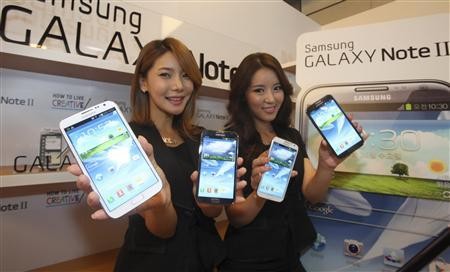
Samsung’s Galaxy phones drive record profit


SEOUL — Samsung Electronics reported quarterly profit of $7.3 billion – a fourth straight record quarter and nearly double last year’s figure – as strong sales of its Galaxy smartphones more than offset reduced orders for chips and screens from Apple Inc, the South Korean group’s main rival and leading customer.

But the record run will come to an end in the current quarter as Samsung spends more on marketing to counter Apple’s latest iPhone and other rival products in a crowded $200 billion plus global smartphone market.

This year’s expected record profit of 28 trillion won ($25 billion) will also trigger higher performance related payouts to many of Samsung’s 206,000 staff early next year. And Samsung may have to set money aside this quarter if it fails in an appeal to overturn an August 24 U.S. court ruling that awarded more than $1 billion in damages to Apple for patent infringements by Samsung.

“Fourth-quarter profit will be pressured by one-off expenses: performance payouts and some $1 billion in legal provisioning relating to the Apple litigation. Excluding those, core earnings will remain solid and a swing factor is how much Samsung spends on marketing,” said Lee Sun-tae, analyst at NH Investment & Securities.

Analysts expect earnings at the world’s top technology firm by revenue to decline until the second quarter of next year as a slump in computer sales and the weak global economy sap demand for chips and electronics products.

Ahead of full quarterly results due by October 26, Samsung, valued at $197 billion and the world’s leading maker of TVs, smartphones and memory chips, estimated its July-September operating profit jumped 91 percent to 8.1 trillion won from a year ago – beating an average forecast of 7.6 trillion won in a Reuters survey of 16 analysts.

That would be more than a fifth higher than the previous record in April-June. Samsung estimated its third-quarter revenue at 52 trillion won, in line with market forecasts of 51.7 trillion won.

Samsung shares were up 1.6 percent at 1.39 million won each early on Friday. The stock has risen more than 7 percent since a U.S. court ruled on August 24 that the Korean firm copied parts of Apple’s iPhone and awarded the California-based firm more than $1 billion in damages. Apple is up less than 1 percent.

Profit from the mobile division is likely to have more than doubled to around 5 trillion won, or around two thirds of its total profit, as smartphone shipments are estimated at around 58 million, including 18-20 million Galaxy S IIIs.

Cheap as chips

Strong handset sales made up for reduced profits from its chip business, as prices of its mainstay dynamic random access memory (DRAM) chips, used in computers and mobiles, dropped 14 percent in the September quarter.

Contract prices of DRAM chips now trade below what it costs most manufacturers to make them, and will squeeze near-term earnings, analysts say. Tablets and smartphones, the real growth areas, use far smaller memory storage.

“Meaningful DRAM price increases may be difficult in the near term without more aggressive production cuts,” Goldman Sachs said in a client note this week.

Samsung is expected to reduce its investment in chips next year due to the drop in demand, which could be bad news for semiconductor equipment manufacturers such as ASML. Kwon Oh-hyun, promoted to Samsung CEO in June, said late last month that the group has yet to finalise its 2013 investment plans.

Samsung is beefing up its product line-up, with the latest phone-cum-tablet Galaxy Note expected to go on sale in the United States this month, and its ATIV smartphones that run on Microsoft’s new Windows system to compete with Nokia’s Lumia series.

Despite a bruising series of patent disputes and the reputational risk of the U.S. court defeat in August, Samsung’s brand value has surged this year as it shipped more handsets and smartphones than any of its rivals. The value of the Samsung brand has jumped to 9th in the world – up from 17th last year – at $32.9 billion, according to brand consultancy Interbrand. That’s more than Toyota Motor, but less than half of second-ranked Apple’s $76.6 billion.

source: interaksyon.com

Friday, March 16, 2012

China set to become biggest smartphone market


SINGAPORE — China is set to be the biggest smartphone market this year after shipments in the second-half of 2011 outstripped the U.S., a technology research firm said.

Figures by U.S.-based International Data Corporation (IDC) indicate China will account for 20.7% or almost 137 million units of the global smartphone market from 18.2% in 2011.

In contrast, the U.S. share of the overall market is expected to decline to 20.6% this year from 21.3% in 2011, said IDC, which is projecting 660 million smartphones will be shipped in 2012.

“China smartphone shipments are expected to take a slim lead over the U.S. in 2012 before the gap widens in the coming years,” said Wong Teck Zhung, IDC’s regional senior market analyst with the client devices team.

“There will be no turning back this leadership changeover.”

Much of the growth in smartphone shipments in China, and also for the other emerging markets such as India and Brazil, are being fueled by mobile handsets running on Google’s Android platform, said IDC.

“A lot of the Android models in China are priced competitively,” said Melissa Chau, IDC’s regional research manager. “That is actually driving the huge growth.”

Chau said the average price of a non-Apple smartphone in China sold for $324 excluding telco subsidies last year while an iPhone retailed at a much higher $760.

source: japantoday.com