Showing posts with label Shanghai. Show all posts

Monday, April 25, 2022

China lockdowns, rate hike fears batter stock markets

HONG KONG - Stock markets sank Monday on growing concerns that lockdowns in China aimed at fighting a worsening Covid outbreak could threaten the country's economy and global supply chains.

The losses extended a sell-off across the world last week fuelled by comments from Federal Reserve boss Jerome Powell indicating officials will hike interest rates by half a point next month and possibly several times more by year's end.

China's struggle to get a grip on a Covid outbreak that has forced Shanghai -- the country's biggest city -- into lockdown and dealing a blow to demand.

Officials in the finance hub reported 51 deaths Monday, its highest daily toll despite weeks of strict containment measures, while Beijing warned of a "grim" situation as infections rise.

The lockdowns will "cause a logistical problem that's going to affect not just China but also the rest of the world", OANDA's Jeffrey Halley told Bloomberg TV.

Officials' determination to continue with a zero-Covid policy as well as a lack of government stimulus, "that all points to lower China stocks and we are going to see a weaker yuan going forward".

Investors were already fleeing risk assets as they become worried that the Fed tightening -- to fight inflation at more than 40-year highs -- will knock the pandemic economic recovery off course and dent companies' bottom line.

With earnings season under way, a close eye is being kept on what firms say about the impact on and the outlook for business in light of inflation, forecast rate hikes, supply chain snarls and the Ukraine war.

"Having spent most of the last few weeks trying to put to one side concerns about events in eastern Europe, a slowdown in China, and the increasing risks of what inflation might do to company earnings, as well as consumer incomes, the final straw appears to be a concern about the prospect of a policy mistake by central banks, and a possible recession by the end of the year," said Michael Hewson of CMC Markets.

And Geir Lode, at Federated Hermes, added: "There has been little to avert the investor pessimism as inflation and interest rate expectations start to bite.

"In particular due to the uncertainty of the macro environment, expectations are low with regard to forward estimates and guidance, building on lowered expectations from the previous quarter."

All three main indexes on Wall Street ended more than two percent down Friday, and Asia followed suit with hefty losses.

Hong Kong and Shanghai led the selling, with both markets suffering hefty losses, while Tokyo, Seoul, Singapore, Taipei, Mumbai, Bangkok and Jakarta were also deep in the red.

London, Paris and Frankfurt were sharply lower in the morning.

Sydney and Wellington were closed for holidays.

The hit to demand for energy in China also dragged on crude. WTI fell below $100 a barrel, even as the war in Ukraine hits supplies of the black gold owing to embargoes on Russian exports.

"Oil is rerating lower due to the China consumption hit while the Federal Reserve is raising interest rates to slow down the US economy," said Stephen Innes at SPI Asset Management.

"Those are two gusty headwinds suggesting some oil bulls will give way to recession fears and demand devastation."

On currency markets, the euro was unable to hold a brief rally that came on the back of Emmanuel Macron's victory in France's presidential election, seeing off far-right challenger Marine Le Pen.

Agence France-Presse

Friday, April 8, 2022

Shanghai lockdown snarls world's busiest port and China supply chains

BEIJING — Shanghai's grinding coronavirus lockdown is slowly clogging China's supply chains, as delays hit the world's busiest container port where staff are tangled in a morass of COVID controls.

Beijing has refused to tack away from its strict zero-COVID strategy that has protected its public health system through the pandemic but at a mounting economic cost.

China's financial hub Shanghai -- home to multinational firms and its busiest port -- has been sealed off almost entirely for a week following an outbreak fueled by the Omicron virus variant.

That has many forced companies to halt production and slow new projects, factories told AFP, while those still operating are struggling with a shortage of truck drivers on top of onerous permit and COVID testing requirements.

At Shanghai's port, the lack of drivers and other workers means getting goods in and out is increasingly hard.

The docks are working normally with a "single-digit" number of vessels waiting to berth, Shanghai International Port Group said this week.

"But the fact is... due to restrictions caused for truck drivers, it is not really operating," Bettina Schoen-Behanzin, vice president of the EU Chamber of Commerce's Shanghai Chapter, told AFP.

"The figure I heard is that... week-on-week volumes at the Shanghai port are down by 40 percent. So that's really enormous."

Shortages are starting to bite across China's vast consumer economy, where online shopping platforms such as Taobao face delivery delays, especially of imported goods.

COVID curbs in a number of cities have forced factories to find new suppliers.

But the impact may soon also be felt outside China if lockdowns persist.

Shanghai is the world's number 1 container port, a spinal point in the global supply chain and a key gateway for foreign trade.

It handles around 17 percent of China's total port volume and shipped 47 million TEU -- the standard measurement for cargo, meaning Twenty-foot Equivalent Unit -- in 2021.

FACTORIES CAN'T WORK FROM HOME

Chinese manufacturers say lockdowns, no matter how flexible or targeted, pile pressure on their business.

"Not many roles allow working from home," said Jason Lee, founder of wheelchair producer Megalicht Tech, whose factory in Shanghai's Puxi area has suspended production.

"People can't enter the factory... and because our raw materials come from other provinces or cities, these can't enter Shanghai either," he said.

A Shanghai-based clothing exporter surnamed Zheng said his biggest problem was that he could not send samples to clients.

"Deliveries can neither leave nor enter," he said

Experts say the outbreak is currently nibbling at growth, but could soon take a big bite.

Nomura economists estimate that 23 cities accounting for 22 percent of China's GDP have rolled out full or partial lockdowns.

"The costs of the zero-COVID strategy will rise significantly as its benefits decline, especially as exports are hit by the ongoing lockdowns," Nomura chief China economist Lu Ting told AFP.

That will challenge Beijing's 2022 GDP growth target of around 5.5 percent, he added.

ADAPTING TO SURVIVE

For now, companies are adapting to try and handle the restrictions.

"Our main business activity is down by over 50 percent," said Gao Yongkang, general manager of Qifeng Technology in eastern China's Quanzhou city.

The company has been unable to transport textile materials to regular clients because of the COVID curbs, and has instead pivoted to supplying the booming market for protective gear.

Meanwhile, those who cannot reach their original suppliers are scouring for new ones.

"The costs are a little higher and it's slightly less efficient but we can fulfill our regular needs," said Shen Shengyuan, deputy general manager of diaper-producer New Yifa Group.

In a nod to struggling industries, Premier Li Keqiang this week announced a temporary deferment of old-age insurance premiums for sectors such as catering, retail and civil aviation.

But industry groups say hard lockdowns on major cities such as Shanghai are unsustainable, especially with many Omicron cases presenting light or no symptoms.

"Does the zero-COVID strategy still work in the current environment," said Eric Zheng, American Chamber of Commerce president in Shanghai. 

"That's a big question, particularly when you try to balance the economic cost."

Agence France-Presse

Saturday, March 26, 2022

'Shanghai won't lock down despite COVID spike'

Shanghai on Saturday recorded a sharp rise in Covid-19 cases, but a member of the city's pandemic task force said officials were determined to avoid a full lockdown over the damage it would do to the economy.

Millions of Chinese in affected areas have been subjected to city-wide lockdowns by an Omicron-led outbreak that has sent daily case counts creeping ever-higher, though they remain insignificant compared to other countries.

Shanghai, however, has aimed to ease disruption with a more targeted approach marked by rolling 48-hour lockdowns of individual neighbourhoods and large-scale testing while largely keeping the metropolis of 25 million people running.

At a daily Shanghai press conference Saturday, officials alluded to the importance of avoiding a full lockdown of the huge port city.

"If Shanghai, this city of ours, came to a complete halt, there would be many international cargo ships floating in the East China Sea," said Wu Fan, a medical expert with the city's pandemic task force.

"This would impact the entire national economy and the global economy."

Wu made the comments as city officials also announced that they would begin handing out self-testing kits to Shanghai residents, in the latest sign that the government was expanding its pandemic response.

The northeastern province of Jilin also said Saturday that it had begun distributing 500,000 of the rapid-antigen kits.

Shanghai and Jilin have been the areas hardest hit by the outbreak, which took off in early March. 

China had largely kept the coronavirus -- which first emerged in the city of Wuhan in late 2019 -- under control through its strict zero-tolerance measures.

But that top-down approach is increasingly being questioned amid concerns over the economic impact and public "pandemic fatigue", especially considering Omicron's less severe symptoms.

The National Health Commission announced two weeks ago that it would introduce the sale in China of rapid antigen self-test kits for the first time, and they have begun to appear on pharmacy shelves.

But Saturday's announcements appeared to mark their first wide-scale use as part of official pandemic control measures.

China on Saturday reported 5,600 new confirmed domestic transmissions, most of them asymptomatic.

Chinese authorities had watched nervously as a deadly Hong Kong Omicron surge sparked panic buying and claimed a high toll of unvaccinated elderly in the southern Chinese city.

Its subsequent spread in mainland China has posed a dilemma for authorities wrestling with how forcefully they should respond.

On Wednesday, Shanghai infectious disease expert Zhang Wenhong, a top doctor in the city's pandemic fight, called for balancing anti-virus measures with maintenance of "normal life".

The comments in his widely followed blog indicated growing official tolerance for voices who question the lockdown approach.

Shanghai's softer strategy has so far failed to stop cases from rising, and the localised lockdowns have provoked grumbling online and a run on groceries in some districts.

Shanghai on Saturday reported another steep rise in new local transmissions to 2,269 -- around 40 percent of the national total. 

Agence France-Presse

Friday, March 18, 2022

Shanghai pushes ahead with mass COVID tests as new cases spike

SHANGHAI - The Chinese commercial hub of Shanghai is pushing ahead with a mass testing initiative as it tries to curb a new spike in COVID-19 infections, but some districts were easing lockdown rules in an effort to minimize disruptions.

The city, home to about 25 million people, saw symptomatic local community infections hit 57 on March 17, with another 203 domestically transmitted asymptomatic cases, up from eight and 150 respectively a day earlier.

Shanghai, which has up to now remained relatively unscathed by the coronavirus, has shut schools and launched a city-wide testing program that has seen dozens of residential compounds sealed off for at least 48 hours.

China has been battling its worst COVID outbreak since the virus first emerged in Wuhan in 2020. It reported 2,388 new local cases with confirmed symptoms on March 17, almost double the count a day earlier.

The outbreak is small by international standards and analysts have been debating how much China's uncompromising "zero-COVID" response will hurt the economy at home and in the world at large. 

President Xi Jinping signaled late on Thursday that the "dynamic clearance" policy to contain the outbreak would not be ditched. 

"Victory comes from perseverance," Xi told a Politburo standing committee meeting while calling for more effective measures and efforts to minimize the economic impact, state media reported.

MIXED SIGNALS

The Shanghai government, while stressing there would be no city-wide lockdown as in other cities, said it would test residents on a neighborhood by neighborhood basis, and order 48-hour lockdowns while they waited for their results.

On Friday, there were some signs it was easing up on its restrictions, with some compounds no longer required to go into a 48-hour lockdown while residents were tested.

The head of one residential committee in Changning district said her compound would not be sealed off this weekend as originally planned. At least two other compounds also said testing would be postponed.

While officials said on Thursday that Shanghai has ramped up its testing capacity to 3 million per day and planned to increase it to 5.5 million in the near future, some districts also reported shortages of qualified testing personnel.

Some residents complained about the lack of clarity when it came to the rules. One family quarantined in the district of Hongqiao said they were still locked in despite two negative tests.

Users of China's Weibo microblogging platform also slammed a decision to seal rented accommodation used by outpatients at the Shanghai Cancer Hospital, making it impossible for them to receive treatment.

"Shanghai used to brag the whole day long about its precise epidemic prevention and control... even mocking others for excess prevention and for having inadequate officials," said one user posting under the name BayMax XX. "It's not so great now?"

As of March 17, mainland China had reported 126,234 cases with confirmed symptoms, including both local ones and those arriving from outside the mainland. There were no new deaths, leaving the death toll unchanged at 4,636.

(Reporting by David Stanway, Brenda Goh, Engen Tham and the Shanghai newsroom; Additional reporting by Roxanne Liu and Albee Zhang; Editing by Sam Holmes and Lincoln Feast)

-reuters-

Saturday, August 10, 2019

Super Typhoon Lekima slams into southeast China


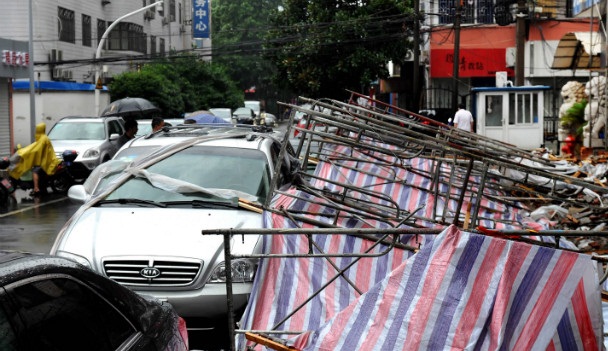
SHANGHAI, China — Super Typhoon Lekima (Philippine name: Hanna) slammed into southeastern China early Saturday, bringing torrential rain and heavy winds that knocked out power, downed thousands of trees and forced more than one million people from their homes, state media reported.

The monster storm made landfall in the early hours in Wenling City packing winds of 187 kilometres per hour (116 miles per hour), and was expected to churn up the east coast towards Shanghai, Xinhua news agency said.

More heavy rain was forecast for the Shanghai area as well as the eastern provinces of Anhui, Fujian, Jiangsu and Zhejiang, with authorities warning of possible flash floods, mudslides and landslides caused by the downpours.

In Zhejiang province alone, nearly 300 flights were cancelled, and ferry and rail services were suspended as a precaution.

More than a quarter of a million people were relocated in Shanghai, where the high-speed maglev train that links the city to one of its airports was suspended.

More than 110,000 people were housed in shelters.

China issued a red alert as the storm approached on Friday, before downgrading the level to orange as winds eased on Saturday morning.

The storm had earlier swept past the northern tip of Taiwan on Friday, where nine people were injured, thousands of homes lost power temporarily and more than 500 flights were cancelled.

Last September, Typhoon Mangkhut slammed into mainland China where authorities evacuated more than two million people, after it left a trail of destruction in Hong Kong and Macau and killed at least 59 people in the northern Philippines.

source: philstar.com

Wednesday, August 8, 2012

Typhoon Haikui strikes east coast of China


(CNN) -- Typhoon Haikui slammed into the east coast of China on Wednesday morning, pummeling the area around the business metropolis of Shanghai with heavy wind and rain.

The storm's winds were at "severe typhoon" strength when it made landfall in the province of Zhejiang, about 225 kilometers (140 miles) south of Shanghai, the China Meteorological Administration said. The winds diminished to typhoon strength as Haikui moved inland.

A severe typhoon is considered to have maximum sustained wind speed of between 150 and 184 kilometers per hour (93 and 114 mph). A typhoon has maximum sustained winds of between 118 and 149 kilometers per hour (73 and 93 mph).


Hundreds of thousands of people had been evacuated from Haikui's path as it approached, the third tropical cyclone to hit China's east coast in less than a week.

Chinese officials had relocated 374,000 people from Shanghai and 250,000 from Zhejiang, according to the state-run newspaper China Daily.

Although the storm's winds are expected to weaken as it moves overland, it will continue to dump large amounts of rain on the surrounding area, raising the risk of landslides and flooding.

"The rain is the bigger impact going forward," said CNNI Meteorologist Taylor Ward. "We have already had up to 8 inches in some locations."

Ward said another 6 to 10 inches of rain were expected to fall, with "maybe isolated amounts greater."

Haikui was moving northwest at 20 kph (12 mph) but was expected to slow over the coming two days, he said.

source: CNN