Showing posts with label Science. Show all posts

Friday, November 22, 2019

From sci-fi to science lab: Holograms you can 'feel'


PARIS, France — Walking, talking holograms have been a staple of sci-fi films since Princess Leia was magically brought to life in "Star Wars".

Now scientists in Britain say they can make even more realistic 3D versions -- a butterfly, a globe, an emoji -- which can be seen with the naked eye, heard and even felt without the need for any virtual reality systems.

Writing in the journal Nature, a team at the University of Sussex in southern England, said technology currently in use can create 3D images but they are slow, short-lived and "most importantly, rely on operating principles that cannot produce tactile and auditive content as well".

To fill in the picture, so to speak, the team created a prototype called Multimodal Acoustic Trap Display (MATD) which "can simultaneously deliver visual, auditory and tactile content".

This uses what is known as "acoustophoresis" -- sound waves that move and manipulate an object, in this case particles -- to form an image in a small box containing arrays of very small speakers.


"Our system traps a particle acoustically and illuminates it with red, green and blue light to control its colour as it quickly scans the display volume," the team said.

Since the system is based on sound waves, it allows the hologram to be heard and even felt.

One of the scientists, Ryuji Hirayama, explained how this last feature -- so crucial to making the object seem real -- works.

"Even if not audible to us, ultrasound is still a mechanical wave and it carries energy through the air. Our system directs and focuses this energy, which can then stimulate your skin to feel content," Hirayama told AFP by email.

"The feeling of the tactile sensation is like a gently spraying your hand with pressurised air."

The system obviously attracts attention because of the science fiction film backdrop but the team said it could have a wide range of applications, from computing to biomedical procedures.

source: philstar.com

Sunday, April 22, 2018

Science Says: Amount of straws, plastic pollution is huge


WASHINGTON  — Cities and nations are looking at banning plastic straws and stirrers in hopes of addressing the world's plastic pollution problem. The problem is so large, though, that scientists say that's not nearly enough.

Australian scientists Denise Hardesty and Chris Wilcox estimate, using trash collected on U.S. coastlines during cleanups over five years, that there are nearly 7.5 million plastic straws lying around America's shorelines. They figure that means 437 million to 8.3 billion plastic straws are on the entire world's coastlines.

But that huge number suddenly seems small when you look at all the plastic trash bobbing around oceans. University of Georgia environmental engineering professor Jenna Jambeck calculates that nearly 9 million tons (8 million metric tons) end up in the world's oceans and coastlines each year, as of 2010, according to her 2015 study in the journal Science .

That's just in and near oceans. Each year more than 35 million tons (31.9 million metric tons) of plastic pollution are produced around Earth and about a quarter of that ends up around the water.

"For every pound of tuna we're taking out of the ocean, we're putting two pounds of plastic in the ocean," says ocean scientist Sherry Lippiatt, California regional coordinator for National Oceanic and Atmospheric Administration's marine debris program.

Seabirds can ingest as much as 8 percent of their body weight in plastic, which for humans "is equivalent to the average woman having the weight of two babies in her stomach," says Hardesty of Australia's Commonwealth Scientific and Industrial Research Organisation.

Organizers of Earth Day, which is Sunday, have proclaimed ending plastics pollution this year's theme. And following in the footsteps of several U.S. cities such as Seattle and Miami Beach, British Prime Minister Theresa May in April called on the nations of the British commonwealth to consider banning plastic straws, coffee stirrers and plastic swabs with cotton on the end.

McDonald's will test paper straws in some U.K. locations next month and keep all straws behind the counter, so customers have to ask for them. "Together with our customers we can do our bit for the environment and use fewer straws," says Paul Pomroy, who runs the fast-food company's U.K. business.

The issue of straws and marine animals got more heated after a 2015 viral video showing rescuers removing a straw from a sea turtle's nose in graphic and bloody detail.

But a ban may be a bit of a straw man in the discussions about plastics pollution. Straws make up about 4 percent of the plastic trash by piece, but far less by weight.

Straws on average weigh so little — about one sixty-seventh of an ounce or .42 grams — that all those billions of straws add up to only about 2,000 tons of the nearly 9 million tons of plastic waste that yearly hits the waters.

"Bans can play a role," says oceanographer Kara Lavendar Law, a co-author with Jambeck of the 2015 Science study. "We are not going to solve the problem by banning straws."

Scientists say that unless you are disabled or a small child, plastic straws are generally unnecessary and a ban is start and good symbol. These items that people use for a few minutes but "are sticking round for our lifetime and longer," Lippiatt says.

Marcus Eriksen, an environmental scientist who co-founded the advocacy group 5 Gyres, says working on bans of straws and plastic bags would bring noticeable change. He calls plastic bags, cups and straws that break down in smaller but still harmful pieces the "smog of microplastics."

"Our cities are horizontal smokestacks pumping out this smog into the seas," Eriksen says. "One goal for advocacy organizations is to make that single-use culture taboo, the same way smoking in public is taboo."

Steve Russell, vice president of plastics for the American Chemistry Council, said people can reduce waste by not taking straws, but "in many cases these plastics provide sanitary conditions for food, beverages and personal care."

The key to solving marine litter, Russell says, is "in investing in systems to capture land-based waste and investing in infrastructure to convert used plastics into valuable products."

Even though Jambeck spends her life measuring and working on the growing problem of waste pollution, she's optimistic.

"We can do this," Jambeck says. "I have faith in humans."

___

AP Retail Writer Joseph Pisani contributed from New York.

source: philstar.com

Wednesday, February 10, 2016

Astronomers identify hundreds of new galaxies behind Milky Way


SYDNEY -- There's a mysterious force pulling the Milky Way galaxy towards it at 2 million kilometers per hour and scientists may have finally found out why.

An international team of researchers led by the International Center for Radio Astronomy Research at the University of Western Australia (UWA) have discovered 883 galaxies hidden in the nearby universe, 250 million light-years from earth, behind the Milky Way, a third of which had never been seen before.

"An average galaxy contains 100 billion stars, so finding hundreds of new galaxies hidden behind the Milky Way points to a lot of mass we didn't know about until now," University of Cape Town professor of Astronomy, Renee Kraan-Korteweg said in a statement on Wednesday.

The study's lead author, UWA professor of radio astronomy Lister Staveley-Smith said this discovery may help explain the "Great Attractor" region that is pulling the Milky Way and several other galaxies towards it with the gravitational force equivalent to a million, billion Suns.

"We don't actually understand what's causing this gravitational acceleration on the Milky Way or where it's coming from," Staveley-Smith said.

"We know that in this region there are a few very large collections of galaxies we call clusters or superclusters, and our whole Milky Way is moving towards them at more than two million kilometers per hour."

Astronomers have been trying to map the galaxies hidden in the so-called Zone of Avoidance, a part of the sky obscured by the Milky Way, since major deviations in the rate of expansion of the universe in this area were detected during the 1970s and 1980s.

By using Australia's chief scientific body CSIRO's Parks radio telescope, located in the middle of a sheep paddock in central New South Wales state and used in NASA's Apollo missions, the team were able to see through the stars and dust of the Milky Way into Zone of Avoidance.

"We've used a range of techniques but only radio observations have really succeeded in allowing us to see through the thickest foreground layer of dust and stars," Kraan-Korteweg said.

The Parks radio receiver, known in Australia as The Dish, has recently been fitted with innovative technologies, such as a 21-cm multi-beam receiver, that allow scientists to map the sky 13 times faster that they could before.

The study, published on Wednesday in the Astronomical Journal, involved researchers from Australia, South Africa, the United States and the Netherlands.

source: interaksyon.com

Thursday, November 13, 2014

European space probe lands on comet, but fails to anchor down


BERLIN/FRANKFURT - The European Space Agency landed a probe on a comet on Wednesday, a first in space exploration and the climax of a 10-year-odyssey, but an anchoring system problem may hamper planned investigations into the origins of Earth and the solar system.

The 100-kg (220-pound) lander - virtually weightless on the comet's surface - touched down on schedule at about 11 a.m. ET after a seven-hour descent from its orbiting mothership Rosetta, now located a half-billion kilometers (300 million miles) from Earth.

But during the free-fall to the comet’s surface, harpoons designed to anchor the probe, named Philae, failed to deploy. Flight directors are considering options to ensure the lander does not drift back into space.

“The lander may have lifted off again,” Stefan Ulamec, Philae lander manager at the DLR German Aerospace Center, told reporters. "Maybe today we just didn’t land once, but landed twice. Hopefully we are sitting there on the surface … and can continue our science sequence.”

Scientists hope that samples drilled out from the comet, known as 67P/Churyumov-Gerasimenko, will unlock details about how the planets – and possibly even life – evolved, as the rock and ice that make up comets preserve ancient organic molecules like a time-capsule.

Comets date back to the formation of the solar system some 4.6 billion years ago. Scientists suspect impacting comets delivered water to early Earth.

"How audacious, how exciting, how unbelievable to be able to dare to land on a comet," NASA's director of Planetary Science, Jim Green, said at the European Space Operations Centre in Germany after the successful touchdown.

Manmade craft have now landed on seven bodies in space: the moon, Mars, Venus, Saturn's moon Titan, two asteroids and comet Tempel-1, which was hit by a NASA probe.

Among several records set by the mission, Rosetta has become the first spacecraft to orbit a comet rather than just flying past to take pictures.

Rosetta reached the comet, a roughly 3-by-5 km rock discovered in 1969, in August after a journey of 6.4 billion km that took 10 years, five months and four days - a mission that cost close to 1.4 billion euros or $1.8 billion. ($1 = 0.8022 euro)

"What really nails this experience for me are the images," Daniel Brown, an expert in astronomy at Nottingham Trent University, said via email after three-legged Philae had relayed data and images back to Earth as it moved toward the comet.

"Especially exciting will be getting the results of the samples recovered from below the surface and seeing their chemical composition," he said. (Additional reporting by Irene Klotz in Cape Canaveral, Florida)

source: interaksyon.com

Monday, September 22, 2014

NASA's MAVEN spacecraft enters Mars orbit


WASHINGTON DC - NASA's MAVEN spacecraft began orbiting Mars on Sunday, on a mission to study how the Red Planet's climate changed over time from warm and wet to cold and dry.

"Based on observed navigation data, congratulations. MAVEN is now in orbit," said Dave Folta of NASA's Goddard Space Flight Center just before 10:30 p.m. (0230 GMT).

The unmanned orbiter has traveled more than 10 months and 442 million miles (711 million kilometers) to reach Mars for a first-of-its kind look at the planet's upper atmosphere.

The data from the Mars Atmosphere and Volatile Evolution (MAVEN) spacecraft aims to help scientists understand what happened to the water on Mars and the carbon dioxide in its atmosphere several billion years ago.

How Mars lost its atmosphere is one of science's biggest mysteries. The answers could shed light on the planet's potential to support life -- even if that was just microbial life -- long ago.

MAVEN's findings are also expected to help add to knowledge of how humans could survive on a future visit to the Red Planet, perhaps as early as 2030.

"Mars is a cool place, but there is not much atmosphere," said John Clarke of the MAVEN science team.

"It is very cold, it is well below zero. The atmosphere is about half a percent of what we are breathing," he added.

"But we know that Mars could change and it was probably different in the past. There is a lot of evidence of flowing water on the surface from Mars's ancient history."

Mission begins

Next, MAVEN will enter a six-week phase for tests.

It will then begin a one-year mission of studying the gases in Mars's upper atmosphere and how it interacts with the sun and solar wind.

Much of MAVEN's year-long mission will be spent circling the planet 3,730 miles above the surface.

However, it will execute five deep dips to a distance of just 78 miles above the Martian landscape to get readings of the atmosphere at various levels.

NASA is the world's most successful space agency at sending rovers and probes to Mars, and past missions have included the Viking 1 and 2 in 1975 and the Mars Reconnaissance Orbiter in 2005.

The US space agency's latest robotic vehicle, Curiosity, is exploring Gale Crater and Mount Sharp, looking for interesting rocks and returning data on whether the Martian environment shows evidence of a past ability to support life.

Later this week, an Indian spacecraft, the Mars Orbiter Mission, will be on course to reach Mars.

The unmanned MOM probe is set to enter Mars's orbit in the next few days after 10 months in space, marking India's first mission to the planet to search for evidence of life.

"We are not the only show that is happening on Mars this week," said Gary Napier, a spokesman for Lockheed Martin, during a NASA television broadcast of the orbital insertion.

"Everyone at NASA and its partners wishes that team all the best."

source: interaksyon.com

Friday, June 20, 2014

Chile hilltop razed for world's largest telescope


SANTIAGO -- Construction on the world's largest optical telescope began with a bang Thursday, as workers demolished a hilltop in Chile's Atacama desert.

The European Extremely Large Telescope, being built by the European Southern Observatory, aims to give astronomers new insight into the origins of the universe and help search for potentially habitable planets elsewhere in the galaxy.

Currently, "we have no proof of the existence of an Earth-like planet at the same distance from the sun in our galactic neighborhood," said astronomer Fernando Comeron, ESO's representative in Chile.

"That's not because they don't exist but because we didn't yet have the tools to detect them.

"With the E-ELT, we can."

Construction will take an estimated 10 years, and the telescope will be put into service two years later.

The first step, estimated at $1.4 billion, involves razing around 5,000 cubic meters (177,000 cubic feet) of rock off the top of Mount Armazones.

The newly flat surface will support the foundation of the telescope, with an "eye" -- a main mirror -- of 39 meters (128 feet) in diameter.

The new telescope's light-collecting surface "will be 10 to 15 times greater than those of existing telescopes," Comeron said.

Thanks to its dry and cold climate, and the lack of light pollution from cities in the remote region, Chile's Atacama desert provides an ideal location for astronomical research.

The ESO, a collaboration involving 15 mainly European countries, operates a number of high-powered telescopes in Chile, including the Very Large Telescope array and the Atacama Large Millimeter/Submillimeter Array, or ALMA.

source: interaksyon.com

Sunday, March 23, 2014

What would happen if carbon emissions continue to rise? UN scientists paint grim picture of future


PARIS - UN scientists are set to deliver their darkest report yet on the impacts of climate change, pointing to a future stalked by floods, drought, conflict, and economic damage if carbon emissions go untamed.

A draft of their report, seen by AFP, is part of a massive overview by the Intergovernmental Panel on Climate Change (IPCC), likely to shape policies and climate talks for years to come.

Scientists and government representatives will meet in Yokohama, Japan, from Tuesday to hammer out a 29-page summary. It will be unveiled with the full report on March 31.

"We have a lot clearer picture of impacts and their consequences... including the implications for security," said Chris Field of the United States' Carnegie Institution, who headed the probe.

The work comes six months after the first volume in the long-awaited Fifth Assessment Report declared scientists were more certain than ever that humans caused global warming.

It predicted global temperatures would rise 0.3-4.8 degrees Celsius (0.5-8.6 degrees Fahrenheit) this century, adding to roughly 0.7 C since the Industrial Revolution. Seas will creep up by 26-82 centimetres (10.4-32.8 inches) by 2100.

The draft warns costs will spiral with each additional degree, although it is hard to forecast by how much.

Warming of 2.5 C over pre-industrial times -- 0.5 C more than the UN's target -- may cost 0.2-2.0 percent of global annual income, a figure that could amount to hundreds of billions of dollars each year.

"The assessments that we can do at the moment probably still underestimate the actual impacts of future climate change," said Jacob Schewe of the Potsdam Institute for Climate Impact Research (PIK) in Germany, who was not involved in the IPCC drafting.

Many scientists concurred, he said, that recent heatwaves and floods were evidence of climate change already on the march -- and a harbinger of a future in which once-freakish weather events become much less rare.

Among the perils listed in the draft are these:

-- FLOODING: Rising greenhouse-gas emissions will "significantly" boost the risk of floods, with Europe and Asia particularly exposed. In the highest warming scenarios of untamed greenhouse gas emissions, three times as many people will be exposed to severe river flooding as with lower warming.

- DROUGHT: For every 1 C (1.8 F) rise in temperature, another seven percent of the world's population will see renewable water resources decline by a fifth.

- RISING SEAS: If no measures are taken, "hundreds of millions" of coastal dwellers will be displaced by 2100. Small-island states and East, Southeast, and South Asia will be the biggest land-losers.

- HUNGER: Average yields of wheat, rice, and corn may fall by two percent per decade, while demand for crops is likely to rise by up to 14 percent by 2050 as Earth's population grows. The crunch will hit poor, tropical countries worst.

- SPECIES LOSS: A "large fraction" of land and freshwater species may risk extinction, their habitat destroyed by climate change.

Security threat

Poverty, migration, and hunger are invisible drivers of turbulence and war, as they sharpen competition for dwindling resources, the report warns.

"Climate change over the 21st century will lead to new challenges to states and will increasingly shape national security policies," its draft summary says.

"Small-island states and other states highly vulnerable to sea-level rise face major challenges to their territorial integrity.

"Some transboundary impacts of climate change, such as changes in sea ice, shared water resources, and migration of fish stocks, have the potential to increase rivalry among states. The presence of robust institutions can manage many of these rivalries to reduce conflict risk."

By reducing carbon emissions "over the next few decades," the world can stave off many of the worst climate consequences by century's end, says the report.

The IPCC will issue a third volume, on strategies for tackling carbon emissions, in Berlin on April 13.

The panel has issued four previous "assessment reports" in its quarter-century history.

Each has sounded a louder drumbeat of warning about the gigatonnes of carbon dioxide spewed by traffic, power station,s and other fossil-fuel burners and methane from deforestation and farming.

The Yokohama volume goes further than its predecessors in forecasting regional impacts in greater detail and emphasizing the risk of conflict and rising seas.

The IPCC's last big report in 2007 helped unleash political momentum leading to the 2009 UN climate summit in Copenhagen. But its reputation was dented by several mistakes, seized upon by climate skeptics as proof of bias.

source: interaksyon.com

Monday, December 30, 2013

Synchronize your watch with DOST on New Year's


MANILA - Welcome 2014 by synchronizing your timepieces with Philippine Standard Time (PhST), the Department of Science and Technology Secretary Mario Montejo is inviting Filipinos as the department partnered with telecoms giants in this endeavor.

“We urge Filipinos to synchronize their watches with PhST in welcoming New Year’s Day,” said Montejo.

The effort is in connection with Republic Act 10535, or the Philippine Standard Time Act of 2013, requiring all national and local government offices as well as broadcasting organizations to display PhST as provided by the DOST’s Philippine Atmospheric, Geophysical, and Astronomical Services Administration (Pagasa), the country’s official timekeeper.

The new law, together with its recently published Implementing Rules and Regulations (IRR), also provides for the observance of the National Time Consciousness Week, set to make its debut on New Year’s Day, 1 January 2014, with the theme “Juan Time: PinoyAko, On-Time Ako!”

 “Our Juan Time campaign seeks to reverse the negative connotations of Filipino Time from tardiness to punctuality, discipline, and utmost regard for other people’s time. Lateness often leads to missed opportunities. What we want is for Filipinos to arrive on time as the new norm,” Montejo added.

For his part, DOST Assistant Secretary Raymund Liboro noted that the New Year is the right time for Filipinos to start following PhST. He added that the leading telecommunications service providers have already been synchronized with PhST.

"Smart is pleased to be an active partner of the ‘Juan Time’ Philippine Standard Time Campaign of DOST,” said Ramon Isberto, head for Public Affairs of Smart Communications.

“The theme ‘PinoyAko, On Time Ako’ is very appropriate in the context of keeping our diverse country of more than 7,000 islands in step with the world. Smart is committed to do its part in making sure that its 50 million subscribers will benefit from this Philippine Standard Time campaign," he added.

According to Globe Telecom Corporate Communications Head Yoly Crisanto, "Globe actively supports the observance of the National Time Consciousness Week by activating various initiatives through the power of our modernized network and social media to reach out to all Filipinos, enjoining them to observe a common reckoning of time across the country. With the implementation of the Philippine Standard Time, we are one with our countrymen in starting 2014 on time and observing thereafter Filipino Time as being Juan Time, On Time."

Join Juan Time. Synchronize your watch with the Philippine Standard Time (PhST) via: http://bit.ly/SyncPhST. Like Facebook: https://www.facebook.com/PhilippineStandardTime. Follow us on Twitter: @PhST_DOST.

source: interaksyon.com

Sunday, November 24, 2013

Quiet Sun prompts questions about impact on Earth


WASHINGTON DC - The surface of the sun has been surprisingly calm of late -- with fewer sunspots than anytime in in the last century -- prompting curious scientists to wonder just what it might mean here on Earth.

Sunspots have been observed for millennia -- first by Chinese astronomers and then, for the first time with a telescope, by Galileo in 1610.

The sunspots appear in roughly 11-year cycles -- increasing to a daily flurry and then subsiding drastically, before amping up again.


But this cycle -- dubbed cycle 24 -- has surprised scientists with its sluggishness.

The number of spots counted since it kicked off in December 2008 is well below the average observed over the last 250 years. In fact, it's less than half.

"It is the weakest cycle the sun has been in for all the space age, for 50 years," National Oceanic and Atmospheric Association physicist Doug Biesecker told AFP.

The intense electromagnetic energy from sunspots has a significant impact on the sun's ultraviolet and X-ray emissions as well as on solar storms.

Solar storms can interrupt telecommunications and electronic networks on Earth. Sunspot activity can also have an impact on the Earth's climate.

Cycle 23 hit its maximum in April 2000 with an average of 120 solar spots a day. The cycle then wound down, hitting bottom around December 2008, the point at which scientists marked the start of the current cycle.

The minimal solar activity at the end of cycle 23 led astronomers to predict a slow cycle 24. But the reality fell even below expectations.

In the first year of the cycle, during which solar activity should have risen, astronomers counted 266 days without a single sun spot.

"The forecast peak was 90 sunspots," Biesecker said, noting that even though the activity has risen over the past year, "it's very clear it is not going to be close to 90."

"The sunspots number peaked last year at 67, almost half a typical cycle," he added.

The last time a sunspot cycle was this slow was in February 1906, the peak of cycle 14, with just 64 spots a day.

The "very long minimum: three years, three times more than the previous three cycles of the space age" was a major surprise, said University of Montana physicist Andres Munoz-Jamillio.

A magnetic switch

Cycle 24 has also diverged from the norm in another surprising way.

Typically, around the end of each 11-year sunspot cycle, the sun's magnetic fields switch direction. The northern and southern hemispheres change polarity, usually simultaneously.

During the swap, the strength of the magnetic fields drops to near zero and reappears when the polarity is reversed, scientists explain.

But this time, something different seems to be happening. The north pole already reversed its polarity several months ago -- and so it's now the same polarity as the south pole.

According to the most recent satellite measurements, "the south hemisphere should flip on the near future," said Todd Hoeksema, director of the Wilcox Solar Observatory at Stanford University.

He didn't seem concerned about the phenomenon.

But scientists are watching the sun carefully to see whether cycle 24 is going to be an aberration -- or if this solar calmness is going to stretch through the next cycle as well.

"We won't know that for another good three or four years," said Biesecker.

Some researchers speculate this could be the start of a prolonged period of weak solar activity.

The last time that happened, during the so-called "Maunder Minimum" between 1650 and 1715, almost no sunspots were observed. During the same period, temperatures dropped sharply on Earth, sparking what is called the "Little Ice Age" in Europe and North America.

As the sunspot numbers continue to stay low, it's possible the Earth's climate is being affected again.

But thanks to global warming, we're unlikely to see another ice age. "Things have not started to cooling, they just have not risen as quickly," Biesecker said.

source: interaksyon.com

Thursday, October 24, 2013

Scientists find farthest galaxy so far


CAPE CANAVERAL, Florida -- Astronomers have found the most distant galaxy yet, a discovery that pushes back scientists' view of the universe to about 700 million years after it is thought to have come into existence.

Light from the galaxy, designated by scientists as z8_GND_5296, took about 13.1 billion years to reach the orbiting Hubble Space Telescope and the Keck Observatory in Hawaii, both of which detected the galaxy in infrared light.

"We are learning so much about a region so far back in time it's hard to comprehend. This galaxy we're seeing is almost 13.1 billion years ago and so this was something like 8 billion years before our sun was even born and of course much longer after that until life came around," said lead researcher Steven Finkelstein, an assistant professor with the University of Texas at Austin.

Surprisingly, out of a pool of 43 candidate distant galaxies, z8_GND_5296 was the only one that revealed the key chemical evidence needed to confirm its distance.

That left Finkelstein and colleagues wondering if they had uncovered a clue to a bigger mystery: How soon did light from the universe's first stars and galaxies pierce an obscuring veil of hydrogen gas that existed early in its history?

Scientists believe that at some point, high-energy ultraviolet radiation from exploded stars split the intergalactic hydrogen atoms into electrons and protons. Once ionized, the hydrogen would be electrically conductive and no longer scatter light.

That may have happened about the time of z8_GND_5296's existence.

The galaxy, which is about a billion times as massive as the sun, has two unusual characteristics, which may be a factor in why it is visible, while potential sister galaxies are not.

First, z8_GND_5296 is forming stars at a very fast pace, pumping out about 100 times more stars than the Milky Way galaxy, so it may be brighter than the other candidate galaxies.

Second, it contains a surprisingly high percentage of elements heavier than hydrogen and helium.

Those elements are forged by nuclear fusion inside stars, so either the galaxy contains the exploded remains of lots of massive stars or it formed in a region of space that had been previously seeded with the remnants of a prior generation of stars, scientists said.

"It could be that this one galaxy lives in an over-dense region of (ionized hydrogen) so we can see it ... but that's a little bit of conjecture. For all we know these other galaxies have just a lot more hydrogen gas within the galaxies themselves and that's why we can't see them," Finkelstein said.

He and colleagues hope to conduct a wider survey for ancient galaxies with Hubble, but more details about z8_GND_5296 will likely have to wait until NASA launches its successor observatory, the James Webb Space Telescope, targeted for launch in 2018.

The research appears this week in the journal Nature.

source: interaksyon.com

Friday, March 15, 2013

Canadian space station commander floats through chat with school kids


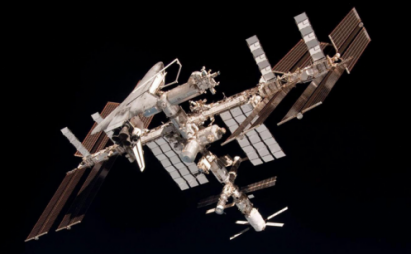
MONTREAL -- The Canadian commander of the International Space Station delighted schoolchildren in a live question and answer session conducted from space on Friday.

Chris Hadfield, who became the first Canadian to take command of the ISS on Wednesday, thrilled his young audience as he floated around during the grilling before signing off with a somersault.

The Q&A was moderated by Canadian Prime Minister Stephen Harper and was broadcast live on television.

Hadfield reflected on a range of questions, including the occasional fears he encounters in space, as well as the awe he feels observing Canada from his vantage point more than 330 kilometers (205 miles) above Earth.

"It is a great way, every time, to wait for Canada, to come around the world again, it just warms my heart, every time, to see the potential of our country and to see the way that we live there together," Hadfield said.

However, the most striking country visible from space is the Bahamas, Hadfield revealed.

"Because of the coral reefs, the colors are absolutely incredible, all the different blues, the different hues of blue, like a rainbow under the water," he said. "It is absolutely incredible to see it. It is beautiful."

Harper wrapped up the session by paying tribute to Hadfield's pioneering spirit.

"You represent the kind of spirit we had in the explorers who found our country and built our country and you are carrying that into a modern age," Harper said. "We are proud of you and we wish you good luck and success."

source: interaksyon.com

Saturday, September 8, 2012

Overfishing pushes tuna stocks to the brink - experts


JEJU, South Korea - Global tuna stocks are fast reaching the limits of fishing sustainability, decimated by an absence of comprehensive, science-based catch limits, conservation experts warned Saturday.

Five of the world's eight tuna species are already classified as threatened or nearly threatened with extinction, according to the Red List of Threatened Species compiled by the International Union for Conservation of Nature (IUCN).

At the IUCN's World Conservation Congress currently underway in South Korea's southern Jeju Island, experts said partial quotas currently in place were inadequate and uninformed.

"The problem is, there is lack of science-based catch limits to ensure effective management and conservation," said Amanda Nickson, Director of Global Tuna Conservation at the Pew Environment Group.

The five Regional Fisheries Management Organisations (RFMOs) that manage the global tuna fishing industry do have some measures in place, including restricting the catch of certain species to the amount caught in a previously defined year.

They also operate "input controls" that, among other things, limit the number of fishing vessels, but Nickson argued these were ineffective as they simply provided an incentive to develop more effective fishing methods.

While acknowledging that scientific data on tuna stocks was "imperfect", Nickson said the UN Fish Stocks Agreement specifically provided for the setting of catch limits if the evidence in favour was compelling enough.

"There is sufficient science available to set precautionary limits," Nickson said.

"If we wait five, 10 years for the science to be perfect, in the case of some species we may not have anything left to manage," she added.

The Atlantic bluefin species, which can live to 40 years old and grow to more than four metres (13 feet) long, is in the gravest danger of disappearing with stocks estimated in some areas to have halved over four decades.

It is so highly prized by sushi-loving Japanese that a 269-kilogram (592-pound) fish went for a record 56.49 million yen ($737,000 at the time) in January auctions.

"The message is that some tuna species are in bad shape," said Bruce Collette, chair of the IUCN Tuna and Billfish Specialist Group.

"Long living and high value tunas are threatened by over exploitation and under regulation by the regional agencies," Collette warned.

The global tuna industry is an economic juggernaut, with fishing in the Pacific Ocean alone -- accounting for 65 percent of the global commercial catch -- worth around $5.5 billion a year.

Toshio Katsukawa, a fisheries expert from Mie University in Japan, said only urgent international cooperation could safeguard the future of the Pacific bluefin tuna.

"Immediate action is necessary" because the risk of commercial extinction is immediate, Katsukawa said.

source: interaksyon.com

Monday, August 6, 2012

NASA: Mars Curiosity Beams First High-Res Pic


In an almost giddy late-night press conference, the NASA Mars laboratory Science team celebrated the Curiosity Rover’s successful landing on a “nice, flat spot — beautiful, really beautiful” on Mars. It’s a patch of dusty land that’s since been immortalized in a couple of low-resolution thumbnails that arrived at mission control moments after Curiosity touched down. Now there’s a new pic — and Curiosity’s new home is coming into focus.

The image arrived early this morning, around the same time that the MLS team sat down for their first post-landing press conference. According to the NASA.gov web site, the image was captured with Curiosity’s fish eye lens (part of a pair of lenses) and is actually half of its full resolution capabilities. The camera lens was protected by a dust cover during landing, which has since sprung open. “The cameras are looking directly into the sun, so the top of the image is saturated. Looking straight into the sun does not harm the cameras. The lines across the top are an artifact called ‘blooming’ that occurs in the camera’s detector because of the saturation,” said NASA.

The landing “looked extremely clean,” said Dr. Adam Steltzner, Mechanical Systems Lead, who has been with the mission since its inception almost a decade ago. Steltzner’s been mostly unknown to the public, but in recent days the scientist has been thrust into the spotlight. He joined Twitter less than a week ago and has been tweeting a mission play-by-play and amassing followers ever since. This was his last tweet before finally grabbing some shut-eye:


John Holdren, the President’s science advisor and the director of Office of Science and Technology Policy, called the effort, “The most challenging mission ever attempted in the history of robotics space exploration.”

NASA Administrator Charles Bolden cheered the Curiosity landing, explaining that “new technologies never invented or attempted before were created for this journey,” and that the odds for success were actually just 40%.

“Curiosity, the most sophisticated Rover ever built is now on the surface of the red planet,” said Bolden, “where it will seek to answer age old questions about whether or not life ever existed there on Mars or if the planet can sustain life in the future.”

NASA, which recently shuttered its Space Shuttle program and has outsourced manned space flight to a consortium of private companies, including SpaceX, spent a reported $2.5 billion on the Curiosity mission. NASA funding has long been a point of contention for space program critics, and Bolden may have been addressing them when he added this impromptu comment during the press conference:

“Tonight, I’m probably not going to include the counties, at least 4 countries — and I won’t name them– who are on Mars, and they’re on Mars because they went with the United States. I know this may sound a little strange in this international environment, but I want everyone to understand what I say and what I mean when I say: Our leadership is gonna make this world better”

source: mashable.com