Showing posts with label Crisis. Show all posts
Tuesday, April 21, 2020
Continued oil market turmoil weighs on global stocks
Oil-price turmoil gripped markets once more Tuesday, a day after US crude futures crashed below zero for the first time as the coronavirus crisis crippled global energy demand and worsened a supply glut.
The commodity rout also sent world equity markets spiraling lower, as investors fretted it could compound an expected deep global economic downturn.
The benchmark WTI price collapsed Monday to an unprecedented low of minus $40.32. Negative prices mean traders must pay to find buyers to take physical possession of the oil -- a job made difficult with the world's storage capacity at bursting point.
A day after its historic slide into negative territory amid a supply glut, US oil futures finished in positive territory.
But the market remained under heavy pressure due to the oversupply as coronavirus shutdowns constrain global growth.
Storage is a particularly big problem in the US where WTI oil is delivered at a single, inland point.
In Europe, where Brent is the benchmark, there are several delivery sites and their proximity to the sea allows some of it to be stored on tankers.
"Players are now paying buyers to take oil volumes away as the physical storage limit will be reached. And they are paying top dollar," said Rystad Energy analyst Louise Dickson.
This week's massive sell-off came just ahead of Tuesday's expiration of the May contract. Most trading has now moved to the June contract, and May WTI was back in positive territory by the close of New York trading.
- 'Slice of pizza' -
Oil markets have been ravaged this year after the pandemic was compounded by a price war between Saudi Arabia and Russia.
"Ever thought that it could be imaginable to see the price of US oil valued at less than a pizza? Or even a slice of pizza? How about for it to actually cost (money) to sell US crude?" said Jameel Ahmad, head of currency strategy and market research at FXTM.
While the two big oil-producing nations have drawn a line under the dispute and agreed with other countries to slash output by almost 10 million barrels a day, that is not enough to offset the lack of demand and prices have remained low.
European benchmark Brent North Sea oil for June delivery tumbled to an 18-year low, before coming off worse levels in volatile deals.
- Stock markets sink -
Equity markets were meanwhile also deep in the red on Tuesday, having enjoyed a healthy couple of weeks thanks to massive stimulus measures and signs of an easing in the rate of new infections globally.
Key eurozone stocks markets closed with declines of up to four percent, while London did a little better thanks to a weaker pound.
On Wall Street, the Dow finished down more than 630 points, or 2.7 percent.
"Continued dysfunction in the crude oil markets" was the main factor behind the decline, analysts at Charles Schwab said, "while the Street continues to assess the timing of when the US economy may be able to reopen."
Analysts warned the drop in stock markets could be an indication that the recent surge may have been hasty, and that another prolonged sell-off is possible.
- Key figures around 2030 GMT -
West Texas Intermediate (May delivery): UP at $10.01 per barrel
West Texas Intermediate (June delivery): DOWN 43 percent at $11.57 per barrel
Brent North Sea crude (May delivery): DOWN 22.1 percent at $19.93
Brent North Sea crude (June delivery): DOWN 24.4 percent at $19.33
New York - Dow: DOWN 2.7 percent at 23,018.88 (close)
New York - S&P 500: DOWN 3.1 percent at 2,736.56 (close)
New York - Nasdaq: DOWN 3.5 percent at 8,263.23 (close)
London - FTSE 100: DOWN 3.0 percent at 5,641,03 points (close)
Frankfurt - DAX 30: DOWN 4.0 percent at 10,249.85 (close)
Paris - CAC 40: DOWN 3.8 percent at 4,357.46 (close)
EURO STOXX 50: DOWN 4.1 percent at 2,791.34 (close)
Tokyo - Nikkei 225: DOWN 2.0 percent at 19,280.78 (close)
Hong Kong - Hang Seng: DOWN 2.2 percent at 23,793.55 (close)
Shanghai - Composite: DOWN 0.9 percent at 2,827.01 (close)
Euro/dollar: DOWN at $1.0859 from $1.0862 at 2100 GMT
Dollar/yen: UP at 107.77 yen from 107.62
Pound/dollar: DOWN at $1.2301 from $1.2442
Euro/pound: UP at 88.27 pence from 87.30
burs-jmb/cs
Agence France-Presse
Thursday, April 16, 2020
Police thy neighbor: Virus fears fuel quarantine shaming
Some complain about joggers panting on passers-by. Others wonder what to do when they overhear drunken partygoers rejecting quarantine measures. Still more question whether people they see in the street are really on "essential" business.
Local social media networks, long places for recipe swaps and restaurant tips, are rapidly becoming sites where neighbors police neighbors during the global coronavirus pandemic.
And as users test the line between civic duty and intrusive surveillance -- often trying to shame their peers into obeying social distancing rules -- experts worry that a practice once frowned upon is becoming normalized.
"It distresses me greatly to see a few uncaring louts who scoff at the safety rules that are meant for all of us to get through this awful situation," said one user on a listserv for a wealthy suburb of the capital Washington, which has seen a slew of complaints about people ignoring distancing guidelines.
"I have a suggestion - if you see such behaviors as mentioned above - why not take photos/videos of the offenders? This could discourage their dangerous behaviors," said another.
Online shaming is nothing new -- and neither is neighbors keeping tabs on one another -- but never in history have so many people had such a high stake in enforcing social rules, or such a fast and accessible platform on which to do so.
"There is a sense that if you do it you can save lives... With COVID-19, we're scared and there is an urgency to enforce the social distancing rules. Shaming is really one of the only tools we have," says Dr Emily Laidlaw, an associate professor at the University of Calgary who studies privacy law and online shaming.
Examples are rife on platforms such as Nextdoor, a hyperlocal social media network which demands users post under their real names and verify their locations.
"My neighbors are all drunk and having a party next door. One of them went on a loud tirade near my door that another month of quarantine is stupid and that he wasn't going to do it," posted one frustrated resident of a middle class west Los Angeles neighborhood recently.
"You need to report them when it's happening because that just means another month for us to be indoors," another user replied.
Public shaming is against community guidelines and comments deemed as falling into the category will be removed, according to the app.
It also touts the Kindness Reminder, a feature announced last year to keep conversations respectful, and which has been modified in recent weeks with language specific to COVID-19.
Wicca Davidson, who runs a listserv for a municipality in Maryland, says that since the pandemic began she has seen an uptick in complaints about behavior.
"We don't want to give a few people the ability to derail the use of the listserv," she told AFP.
- 'Please stop being so judgemental' -
"There's definitely social shaming. That's part of what's working to stay home," 31-year-old Divya Sonti, an employee of IQ Solutions, which specializes in public health communications and health information technology, told AFP.
Privacy expert Laidlaw also believes such policing can be effective.
But "there is a cost that should be acknowledged -- casualties who are taken down by this unfairly, and the normalization of neighborhood surveillance," she said.
One member of the Washington suburb listserv echoed her fears.
"I sympathize with the concern but becoming a police-state type of community isn't healthy," the user wrote.
"This is not ok to take picture of people and post them," another person wrote on a Nextdoor group in Los Angeles, after a user posted photographs of people they felt were walking too closely together. "What is next? Train to Dachau?"
Laidlaw said policing and shaming were already on their way to being normalized online before the pandemic, noting that "shaming sites are not new, nor are neighborhood watch/surveillance sites".
But until now, she says, there was also strong condemnation of public shaming.
"I worry when the dust has settled, what was once contentious will be the new normal."
That is problematic because of the lack of context online, and the speed at which such condemnation can spread.
For example, in Brooklyn, one neighbor complained on Nextdoor about seeing a group of people in the street -- a group which another user said was likely from a local substance abuse meeting.
The sentiment is also echoed in one of the many viral Facebook posts calling for compassion at a time when so many are already struggling to cope.
"Do you ever think maybe that guy buying a gallon of paint knows he must keep busy because idle hands in the past has caused him to relapse and pick up that case of beer?" it reads.
"I know we are all on edge but please stop being so judgemental of others."
Agence France-Presse
Thursday, March 20, 2014
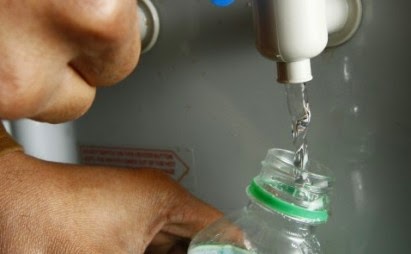
World facing water-energy crisis - UN
PARIS -- Surging populations and economies in the developing world will cause a double crunch in demand for water and energy in the coming decades, the UN said Friday.
In a report published on the eve of World Water Day, it said the cravings for clean water and electricity were intertwined and could badly strain Earth's limited resources.
"Demand for freshwater and energy will continue to increase over the coming decades to meet the needs of growing populations and economies, changing lifestyles and evolving consumption patterns, greatly amplifying existing pressures on limited natural resources and on ecosystems," the report said.
Already, 768 million people do not have access to a safe, reliable source of water, 2.5 billion do not have decent sanitation and more than 1.3 billion do not have mains electricity.
About 20 percent of the world's aquifers today are depleted, according to the report.
Agriculture accounts for more than two-thirds of water use.
The World Water Development Report, the fifth in the series by the UN Educational, Scientific and Cultural Organization, is an overview collated from data from scientific studies and investigations by agencies.
It said ever more freshwater will be needed for farming, construction, drinking, cooking, washing and sewerage, but also for energy production -- 90 percent of which uses water-intensive techniques today.
The report gave this snapshot of the future:
Global water demand is likely to increase by 55 percent by 2050.
By then, more than 40 percent of the world's population will be living in areas of "severe" water stress, many of them in the broad swathe of land from North Africa and the Middle East to western South Asia.
Asia will be the biggest hotspot for bust-ups over water extraction, where water sources straddle national borders. "Areas of conflict include the Aral Sea and the Ganges-Brahmaputra River, Indus River and Mekong River basins," said the report.
Global energy demand is expected to grow by more than a third by 2035, with China, India and Middle Eastern countries accounting for 60 percent of the increase.
In 2010, energy production gobbled up 66 billion cubic metres (2,300 billion cu. feet) of fresh water -- more than the average annual flow of the River Nile in Egypt.
By 2035, this consumption could rise by 85 percent, driven by power plant cooling systems that work with water.
Thirsty energy
Shale deposits and tar sands, driving an energy boom in North America, are especially hefty in their demands for water to force out the precious gas and oil, the report said.
Even so, "they are outstripped by far by biofuels," said researcher Richard Connor, who headed the study.
Renewable sources like solar and wind energy that use far less water are gaining ground, and accounted for about a fifth of global electricity output in 2011, the report said.
But they are unlikely to expand this share significantly if fossil fuels continue receiving the bulk of subsidies, it said.
Oil, gas and coal had subsidies of $523 billion (376 billion euros) in 2011, nearly 30 percent more than in 2010, compared to $88 billion for renewables, the report said, citing International Energy Agency figures.
Africa, Latin America and the Caribbean have plenty of potential for hydro-energy, which reuses the precious resource, it added.
Hydroelectric dams have been extremely controversial. Big projects deliver gigawatts of power but critics say they are ecologically damaging and prone to massive cost overruns.
The review called for a global effort in efficiency gains, pointing the finger at the arid countries of the Middle East where between 15 and 60 percent of water is wasted through leaks or evaporation even before the consumer opens the tap.
The report also called for smart choices in allocating the trillions of dollars likely to be invested in water and energy infrastructure over the next two decades.
source: interaksyon.com
Monday, March 4, 2013
Aquino insists Sabah sojourn of sultan's men a conspiracy, vows to hold plotters liable
MANILA, Philippines – President Benigno Aquino III on Monday reiterated his administration’s theory that the ongoing crisis in Sabah was the result of a conspiracy, and not solely the handiwork of the Sultan of Sulu, and vowed to hold liable those who deliberately put Filipino lives in harm’s way.
Looking grim, Aquino preceded a hastily called press conference with a short speech, saying authorities had evidence that several people, some of them high-profile, others working “in the shadows,” had instigated the mission to send hundreds of the sultan’s followers to Sabah, to reclaim their homeland, triggering the deadly standoff that was broken with sporadic shootings since Saturday. More than a dozen people were dead on both sides, in at least three areas in Sabah.
"Mulat tayo na may mga taong nagkuntsabahan upang humantong tayo sa sitwasyong ito. Isang sitwasying walang agarang solusyon. Ilan po sa kanila ay nakikita natin, habang ang iba naman ay nagkukubli pa rin sa dilim," the President said.
Aquino said Kiram III's group won't be able to launch such action in Sabah without conspirators, whom he said were critics of the government.
He said he had also observed that the critics were espousing only one line to instigate and further worsen the situation, adding that "concerted criticisms all point to a conspiracy."
"Pinalubha nila ang isyung ito at ginagawa nila ito habang nilalagay sa peligro ang daan-daang libong Pilipino," he said.
He warned those behind Kiram III's group that "they will not succeed."
"Pananagutin natin ang mga nagkasala sa bansa," Aquino said.
His earlier assertion last week that the mission was a “conspiracy” had angered Sultan Jamalul Kiram III, and drew flak from critics, who said the President spoke from a position of ignorance and insensitivity by implying the sultanate could be manipulated by others.
Also on Monday, Aquino stood pat on his demand to Kiram III's followeres to lay down their arms, saying a negotiation with the group over its claim to Sabah won't materialize if they would not surrender.
"Hindi pa rin nagbabago ang panawagan ko sa angkan ni Jamalul Kiram III. Hindi resonableng humingi ng pang-unawa kung nakatutok ang iyong armas sa mukha ng iyong kausap. Mgasisimula lamang ang resonableng usapan oras na maging handa kayong huminahon at magtimpi at humarap sa mesa ng may bukas na pag-iisip."
source: interaksyon.com
Subscribe to:
Posts (Atom)