MANILA, Philippines — In July 2016, Smart Communications — the wireless arm of telco giant PLDT, Inc. — came out with a heart-warming TV advertisement targeting a market that had long been ignored by many companies.
In the TV ad, a gay man was debating whether he would accept his father’s friend request on Facebook. As he scrolls through his Facebook profile filled with pictures of him and his partner, the son finally decided to hit the “confirm” button.
“Dad, inaccept na kita (Dad, I’ve accepted you),” read the gay son’s message to his father.
“Anak ako rin (Me too, son),” the father replied. The ad, which went viral on social media, ends with this message: Break barriers for new beginnings.
Five months later, PLDT’s rival Globe Telecom, Inc. released a gay-themed commercial for its international roaming service. The Globe ad features a Pinoy tourist who was smitten by a Thai boy in Bangkok.
With the recent emergence of LGBT-targeted ads in the Philippines, are businesses in Asia’s biggest nominally Catholic nation starting to realize that tapping the gay market makes financial sense?
The ‘pink’ market
Many LGBTs exercise a big role in decision-making in the family, including finances, and some companies in the Philippines are now acknowledging the community’s buying power, which "should never be ignored," said Niño Jose Gonzales, a copywriter at advertising agency BBDO Guerrero.
But Gonzales said businesses in the country “still have a long way to go” especially in creating more LGBT-oriented ads.
In 2015, homegrown fashion brand Bench stirred up controversy when it blacked out the hands of a gay couple for an ad on a billboard on EDSA-Guadalupe, triggering a social media campaign called #PaintTheirHandsBack.
According to reports, Bench later explained that its billboard — which was used to promote the company’s "Love All Kinds of Love" campaign — was not defaced as initially assumed by social media users but censored because the Ad Standards Council "rejected photos of the couple looking lovingly at one another, citing ‘traditional Filipino family values’ as a reason."
Niche market in a conservative country
Meanwhile, many firms don’t see the need to target the LGBT market, arguing that members of the community are already included in the male and female population.
Many corporations are also hesitant to spend millions on ad campaigns targeting a minority sector.
"I think pink money has always been there. As we humans have diverse interests and priorities, members of the LGBT will spend on and distribute their pink money on things that they need and hobbies that interests them. We go to the gym. We spend on groceries. We go on vacation, the list continues," Gonzales, who also teaches marketing and advertising at De La Salle University in Manila, told Philstar.com.
"But to have companies cater exclusively to a niche market, especially in a conservative country like ours, is not yet common," he added.
Results of the “Project Pink” study conducted in 2011 by the Philippine Survey Research Center (PSRC) showed one in 20 Metro Manila residents openly identifies as a member of the LGBT community.
Adding those who are “in the closet,” actual numbers would be higher.
“Interestingly, bisexuals and transgendered individuals have significantly higher purchasing power than straight people,” Andrea Dizon, PSRC associate account director, was quoted as saying in a 2013 article by BusinessWorld. “In fact, awareness for brands is higher among the LGBTs.”
'Most products are biological gender specific'
But for Jade Ilagan, strategy director at independent advertising agency IdeasXMachina, measuring the power of pink money is a difficult task.
"In terms of pink money, I am not so sure about the power it has currently. I don’t think also that there is a way to gauge it as most products, if not all, are still biological gender specific,” Ilagan explained in a separate interview with Philstar.com.
"Take for example sanitary napkins. This product will always benefit from money coming from women, regardless if they are members of the LGBT. I am unaware of products that are sexuality-specific," he added.
"In terms of advertising, I think we are currently doing it. We’ve seen commercials from Bench, Smart, that focus on LGBT-related topics like coming out and acceptance. These forms of advertising could be the ones that encourage purchase from pink money, although it still couldn’t be exclusive," he continued.
Cashing in on Pride month?
LGBT Pride is celebrated in more than 60 countries every year, mostly in June.
This month, companies like Adidas and H&M created rainbow merch to mark the celebration of the Pride movement — a stark contrast to the past when businesses were afraid to associate their brand with LGBT marches and parades.
"I do agree that Philippine companies are now slowly showing their support towards the LGBT community. We see campaigns that foster inclusivity and acceptance towards gay people," BBDO Guerrero's Gonzales said.
"I just hope that these efforts come from well-meaning intentions rather than just a ploy to attract the community for us to support the brands that label themselves as our ally. We know a good soul when we see one," he added.
With big and small businesses wanting a bite of the LGBT market, advocates fear corporations are exploiting a group that has been historically neglected.
Ging Cristobal, project coordinator for Asia at OutRight Action International, said that while LGBT-targeted ads give visibility, companies must tread lightly to avoid perpetuating stereotypes that may further harm the gay community.
Last year's Pride March included statements on the political climate in the Philippines as well as support for workers who were on strike against a condiments giant. With this year's emphasis that Pride is a protest, the community is even more on guard against being used by corporate brands.
A march on Friday to commemorate the 1969 Stonewall riots in New York also put the spotlight on labor contractualization, issues of Philippine sovereignty, and alleged attacks on farming communities, alternative news website Bulatlat.com reports.
The same report quotes "Marky" of LGBTQIA+ group Kasarianlan as saying the community cannot be free until everyone is "because every sector has a member of [the community], be it on the peasants’ sector, fisherfolks, a contractual employee or a student."
Is visibility enough?
The visibility that "pink" ads bring may also not be enough to muster support for legislation that aim to protect the LGBT community, Cristobal also said, adding that it is still up to advocates to convince and educate lawmakers.
In the Philippines, the Senate failed to tackle the anti-discrimination bill before the 17th Congress ended.
The proposed Sexual Orientation, Gender Identity and Expression Equality (SOGIE) bill was meant to address, penalize and prohibit "discrimination, marginalization, and violence on the basis of sexual orientation, or gender identity or expression" and to promote non-discrimination through government programs and initiatives.
According to House Bill 4982, sexual orientation is to whom "emotional, sexual attraction, or conduct" is directed while gender identity is "the personal sense of identity as characterized, among others, by manner of clothing, inclinations, an behavior in relation to masculine or feminine conventions."
Gender expression, meanwhile, is "the communication of gender identity through means such as behavior, clothing, and hairstyles, communication, or body characteristics."
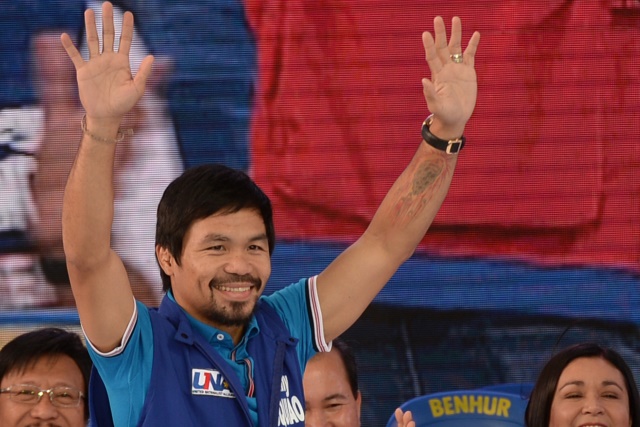
Senators—including Sen. Manny Pacquiao, who is known to base his legislative positions on the Bible—were cool to the idea. Pacquiao argued on the Senate floor in 2017 that "even in the Bible, we can read that women should wear women's clothes and men should wear men's clothes."
He said that not doing so could lead to "fraud" and even put LGBT people in danger, implying that the death of transwoman Jennifer Laude at the hands of US Marine Joseph Scott Pemberton was because she had "fooled" him.
Even President Rodrigo Duterte, who has been quoted as saying LGBT people should not be ashamed of who they are, uses gay as a slur, claiming in February that 40% of communist rebels are gay, and in December 2018 that 90% of priests are.
Had the Senate passed the bill and had it been signed into law, it would have penalized discrimination in, for example, hiring and advancement at work and in refusing services because of a person's SOGIE.
It would also have prohibited and punished "harassment, coercion, or threats from members of institutions involved in law enforcement and the protection of rights on the basis of SOGIE" as well as "outing" someone without their consent.
The 19-year-old measure — which hurdled the House of Representatives in 2017 — will have to be re-filed in the next Congress like other pending bills.
More progress has been made on a local level, with Transgender Philippines noting in 2017 that anti-discrimination ordinances have been passed in 15 cities and one town—including Quezon City and the regional centers of Baguio City, Cebu City, and Davao City.
At the provincial level, Agusan del Norte, Batangas, Cavite, Dinagat Islands, and Iloilo have similar ordinances.
Good intentions, not-so-good execution
Meanwhile, a June 2018 Social Weather Stations survey found that 61% of Filipinos say they will oppose any law that will allow civil union of same-sex couples.
"Capitalism and the ads that businesses create can give visibility. But the question is: What kind of visibility? Do they perpetuate and maintain the stereotypes or do they go beyond the stereotypes and help LGBT activism — maybe show balanced information, balanced messaging?" Cristobal told Philstar.com in a mix of English and Filipino.
"Sometimes, businesses and capitalists don’t know better... Their intention is good but the execution is not that good because they are unwittingly perpetuating stereotypes, thereby causing further discrimination and abuse," Cristobal added.
"The right move is for businesses to engage with activists so they’ll know what will help the community... Advertising agencies should also engage with activists and attend workshops on SOGIE so we can influence how they will execute the campaign of that particular company," Cristobal also said.
source: philstar.com