Showing posts with label Death Toll. Show all posts

Friday, August 20, 2021

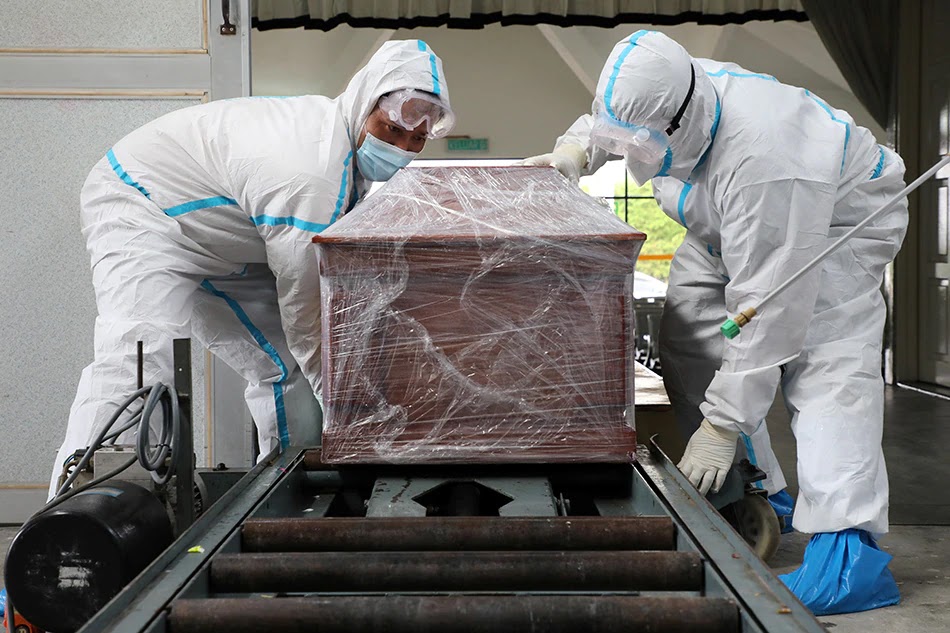
More than 4.4 million dead, 209 million infected with COVID-19 worldwide

The novel coronavirus has killed at least 4,401,486 people since the outbreak emerged in China in December 2019, according to a tally from official sources compiled by AFP at 1000 GMT on Friday. 

At least 209,862,720 cases of coronavirus have been registered. The vast majority have recovered, though some have continued to experience symptoms weeks or even months later. 

The figures are based on daily reports provided by health authorities in each country.

They exclude revisions made by other statistical organizations, which show that the number of deaths is much higher. 

The World Health Organization estimates that the pandemic's overall toll could be two to three times higher than official records, due to the excess mortality that is directly and indirectly linked to Covid-19. 

A large number of the less severe or asymptomatic cases also remain undetected, despite intensified testing in many countries. 

On Thursday, 10,453 new deaths and 687,183 new cases were recorded worldwide. Based on latest reports, the countries with the most new deaths were Indonesia with 1,492, followed by Brazil with 979 and Mexico with 850. 

The United States is the worst-affected country with 625,166 deaths from 37,294,389 cases. 

After the US, the hardest-hit countries are Brazil with 572,641 deaths from 20,494,212 cases, India with 433,589 deaths from 32,358,829 cases, Mexico with 251,319 deaths from 3,175,211 cases, and Peru with 197,716 deaths from 2,138,666 cases. 

The country with the highest number of deaths compared to its population is Peru with 600 fatalities per 100,000 inhabitants, followed by Hungary with 311, Bosnia-Herzegovina with 296, the Czech Republic with 284, Brazil with 269 and the Republic of North Macedonia with 269. 

Latin America and the Caribbean overall has 1,416,393 deaths from 42,452,051 cases, Europe 1,229,171 deaths from 61,347,777 infections, and Asia 742,452 deaths from 48,176,802 cases.

The United States and Canada has reported 651,949 deaths from 38,757,295 cases, Africa 187,324 deaths from 7,418,307 cases, the Middle East 172,587 deaths from 11,605,917 cases, and Oceania 1,610 deaths from 104,576 cases.

As a result of corrections by national authorities or late publication of data, the figures updated over the past 24 hours may not correspond exactly to the previous day's tallies.

Agence France-Presse

Monday, August 24, 2020

Big California wildfires burn on as death toll reaches 7


SCOTTS VALLEY, Calif. (AP) — Firefighters battling three massive wildfires in Northern California got a break from the weather early Monday as humidity rose and there was no return of the onslaught of lightning strikes that ignited the infernos a week earlier.

The region surrounding San Francisco Bay remained under extreme fire danger until late afternoon amid the possibility of of lightning and gusty winds, but fire commanders said the weather had aided their efforts so far.

“Mother Nature’s helped us quite a bit,” said Billy See, the California Department of Forestry and Fire Protection incident commander for a complex of fires burning south of San Francisco.

The three big fires around the Bay Area and many others burning across the state have put nearly 250,000 people under evacuation orders and warnings and authorities renewed warnings for anxious homeowners to stay away from the evacuation zones.

Six people who returned to a restricted area south of San Francisco to check on their properties were surprised by fire and had to be rescued, the San Mateo County Sheriff’s Office said.

The death toll from the fires reached 7 over the weekend after authorities battling a big fire in the Santa Cruz Mountains south of San Francisco announced the discovery of the body of a 70-year-old man in a remote area called Last Chance.

He had been reported missing and police had to use a helicopter to reach the area of about 40 off-the-grid homes at the end of a windy, steep dirt road north of the city of Santa Cruz.

The area was under an evacuation order and Santa Cruz County Sheriff’s Office Chief Deputy Chris Clark said the discovery of the man’s body was a reminder of how important it was for residents to evacuate from fire danger zones.

“This is one of the darkest periods we’ve been in with this fire,” he said.

California over the last week has been hit by 650 wildfires across the state, many sparked by more than 12,000 lighting strikes recorded since Aug. 15. There are 14,000 firefighters, 2,400 engines and 95 aircraft battling the fires.

The Santa Cruz fire is one of three “complexes,” or groups of fires, burning on all sides of the San Francisco Bay Area. All were started by lightning.

Fire crew made slow progress battling the blazes over the weekend, which included a break in the unseasonably warm weather and little wind.

But the National Weather Service issued a “red flag” warning through Monday afternoon for the drought-stricken area, meaning extremely dangerous fire conditions exist, including high temperatures, low humidity, lightning and wind gusts up to 65 mph (105 kph) that officials said “may result in dangerous and unpredictable fire behavior.”

A fire in wine country north of San Francisco and another southeast of the city have within a week have grown to be two of the three largest fires in state history, with both burning more than 500 square miles (1,295 square kilometers).

The wine country fire has been the most deadly and destructive blaze, accounting for five deaths and 845 destroyed homes and other buildings. Three of the victims were in a home that was under an evacuation order.

Officials surveying maps at command centers are astonished by the sheer size of the fires, said Cal Fire spokesman Brice Bennett.

“You could overlay half of one of these fires and it covers the entire city of San Francisco,” Bennett said Sunday.

In Southern California, an 11-day-old blaze held steady at just under 50 square miles (106 square kilometers) near Lake Hughes in the northern Los Angeles County mountains. Rough terrain, hot weather and the potential for thunderstorms with lightning strikes challenged firefighters on Sunday.

Authorities said their firefighting effort in Santa Cruz was hindered by people who refused to evacuate and those who were using the chaos to loot. Santa Cruz County Sheriff Jim Hart said 100 officers were patrolling and anyone not authorized to be in an evacuation zone would be arrested.

“What we’re hearing from the community is that there’s a lot of looting going on,” Hart said.

He and county District Attorney Jeff Rosell expressed anger at what Rosell called the “absolutely soulless” criminals victimizing people already victimized by the fire. Among them was a fire commander who was robbed when he left his fire vehicle to help direct operations.

Someone entered the vehicle and stole personal items, including a wallet and “drained his bank account,” said Chief Mark Brunton, a battalion chief for the California Department of Forestry and Fire Protection.

“I can’t imagine a bigger lowlife,” Hart said.

Holly Hansen, who fled the wine country fire, was among evacuees from the community of Angwin allowed Sunday to return home for one hour to retrieve belongings. She and her three dogs waited five hours in her SUV for their turn. Among the items she took with her were photos of her pets.

“It’s horrible when you have to think about what to take,” she said. “I think it’s a very raw human base emotion to have fear of fire and losing everything. It’s frightening.”

Associated Press

Saturday, April 4, 2020

US sets new global record with 1,480 virus deaths in 24 hours


WASHINGTON, United States — The United States on Friday advised all Americans to wear masks in public to protect against the new coronavirus, fearing the illness that has infected more than one million people worldwide may be spreading by normal breathing.

The recommendation came as the US set a new record for the number of COVID-19 deaths in one day with 1,480 dead, the most of any country since the pandemic began. That topped the record set by the US the previous day with 1,169 deaths.

President Donald Trump said the government recommendation for all 330 million Americans to wear non-medical masks in places such as grocery stores would last "for a period of time."


"It's going to be really a voluntary thing," Trump told reporters. "You don't have to do it and I'm choosing not to do it, but some people may want to do it and that's okay."

US Surgeon General Jerome Adams said the decision came because many people with the virus were showing no symptoms, but warned it was still vital to practice "social distancing" by maintaining space between people.

The announcement came after Anthony Fauci, who is leading the government's scientific response, backed recent scholarship that found SARS-CoV-2 can be suspended in the ultrafine mist formed when people exhale.

Research indicates "the virus can actually be spread even when people just speak as opposed to coughing and sneezing," Fauci said on Fox News.

The National Academy of Sciences sent a letter to the White House on April 1 summarizing recent research on the subject, saying it's not yet conclusive but "the results ... are consistent with aerosolization of virus from normal breathing."

Since the virus was first identified in China in late December last year, health experts have said it is primarily spread through coughing and sneezing.

The US recommendation will likely worsen an already severe shortage of masks in the United States and Europe, which both rely heavily on imports from China.

Trump urged Americans to "just make something" or use scarves, saving clinical masks for health professionals and patients.

Rising tolls but hope in Europe

More than 57,000 people have died from COVID-19 since it was first detected late last year.

Worse may be coming as a quarter of global infections are in the United States, where Trump has warned of a "very, very painful" first two weeks of April.

Europe reached the dark milestone of 40,000 dead, with Spain on Friday reporting more than 900 deaths in the past 24 hours.

Spaniard Javier Lara survived after being put on oxygen in an overcrowded intensive care unit -- a shock to a 29-year-old who was athletic and doesn't smoke.

"I was panicking that my daughter would get infected," he said, describing facing death with an eight-week-old as the "worst moment" in his life.

But there were also signs the peak may be passing in Europe.

Hardest-hit Italy recorded 766 new deaths but its infections rose by just four percent, the lowest yet, according to the civil protection service.

"It's true that the latest figures, as high as they are, give us a little bit of hope," said Chancellor Angela Merkel of Germany.

"But it is definitely much too early to see a clear trend in that, and it is certainly too early to think in any way about relaxing the strict rules we have given ourselves," she added.

'Worst yet to come'

Prosperous countries have borne the brunt of the disease, but there are fears of an explosion among the world's most vulnerable living in conflict zones or refugee camps.

"The worst is yet to come," UN Secretary-General Antonio Guterres said, referring to countries such as Syria, Libya and Yemen. "The COVID-19 storm is now coming to all these theaters of conflict."

The world economy has been pummelled by the virus and associated lockdowns, with the US economy shedding 701,000 jobs in March -- its worst showing since March 2009 in the wake of the subprime banking crisis. Even more dire figures are expected for April.

Financial ratings agency Fitch predicted the US and eurozone economies would shrink this quarter by up to 30 percent and the Asian Development Bank warned the global economy could take a $4.1 trillion hit -- equivalent to five percent of worldwide output.

Latin America is heading into a "deep recession" with an expected drop of 1.8 to 4.0 percent in GDP, according to the UN economic commission for the region.

New measures taken

In signs that the world wants to avoid a repeat of the crisis, the African country of Gabon said it was banning the sale and consumption of bats and pangolins, the critically endangered, scaly mammals.

The novel coronavirus is believed to have come from bats, but researchers think it might have spread to humans via another mammal such as pangolins through an unsanitary meat market in Wuhan, the epicentre of the outbreak in China.

The virus has chiefly killed the elderly and those with pre-existing medical conditions, but recent deaths among teenagers and babies have highlighted the dangers for people of all ages.

In Spain, 34-year-old Vanesa Muro gave birth with COVID-19 and has been warned not to touch her newborn without wearing gloves and masks.

"It's hard," she told AFP. "He grabs your finger, the poor little thing, and holds onto the plastic, not on to you."

Agence France-Presse

Wednesday, April 1, 2020

Now Trump says it's wrong to compare coronavirus to regular flu


WASHINGTON, United States — President Donald Trump said Tuesday that the risk from coronavirus is emphatically worse than regular flu, reversing his previous statements.

Trump told a White House press conference that "a lot of people" had previously suggested the country should simply let the coronavirus take its course, just like the seasonal flu.

"Ride it out, don't do anything, just ride it out and think of it as the flu," they said, according to Trump, who said: "But it's not the flu. It is vicious."

Trump's clear statement contrasted with numerous recent times when he made the argument himself that the pandemic was comparable to the annual spread of flu.

He appeared to favor this thinking while questioning the need to shut down the US economy through social distancing measures and travel bans.

On March 9, for example, Trump noted that tens of thousands of Americans die from the flu annually.

"Nothing is shut down, life & the economy go on," he tweeted. "At this moment there are 546 confirmed cases of CoronaVirus, with 22 deaths. Think about that!"

Just a week ago, Trump told Fox News in an interview that despite deaths of about 36,000 people a year on average from flu, "we've never closed down the country for the flu."

"So you say to yourself, 'What is this all about?'"

Projections that at least 100,000 people will have been killed by the coronavirus in the United States, even if social distancing measures are carried out, appear to have prompted a major shift in Trump's outlook.

On Tuesday, he said that with no social distancing, the projections ran as high as 2.2 million deaths.

"If we did nothing, if we just carried on with our life," he said, "you would have seen people dying on airplanes, you would have seen people dying in hotel lobbies. You would have seen death all over."

Agence France-Presse

Friday, February 21, 2020

Fewer virus cases in China, but deaths abroad increase


BEIJING, China — China on Thursday touted a big drop in new virus infections as proof its epidemic control efforts are working, but the toll grew abroad with deaths in Japan and South Korea.

Fatalities in China hit 2,118 as 114 more people died, but health officials reported the lowest number of new cases in nearly a month, including in hardest-hit Hubei province.

More than 74,000 people have been infected by the new coronavirus in China, and hundreds more in over 25 countries.

The number of deaths outside mainland China climbed to 11.

Japan's toll rose to three as a man and a woman in their 80s who had been aboard a quarantined cruise ship died, while fears there mounted over other passengers who disembarked the Diamond Princess after testing negative.

South Korea reported its first death, and the number of infections in the country nearly doubled Thursday to 104.

Iran reported two deaths on Wednesday and three new cases Thursday. Deaths have previously been confirmed in France, the Philippines, Taiwan and Hong Kong.

Chinese officials say their drastic containment efforts, including quarantining tens of millions of people in Hubei and restricting movements in cities nationwide, have started to pay off.

Chinese President Xi Jinping spoke by phone about the virus with leaders in South Korea and Pakistan, state news agency Xinhua said.

South Korean President Moon Jae-in "chose to call to express sympathies and support" regarding the outbreak, Xinhua said. Xi told him the epidemic's impact on bilateral ties will only be temporary.

Xi told Pakistani Prime Minister Imran Khan that their two countries "are true friends and good brothers," and that combating the virus is his government's top priority.

At a special meeting on the virus with Southeast Asian countries in Laos, China's Foreign Minister Wang Yi said results "show that our control efforts are working."

Although more than 600 new infections were reported Thursday in Hubei's capital Wuhan, it was the lowest daily tally since late January and well down from the 1,749 new cases the day before.

The national figure has  fallen for three straight days.

Chinese authorities placed the city of 11 million under quarantine on January 23 and quickly locked down the rest of the province in the days that followed.

Wuhan authorities this week carried out  door-to-door checks on residents, with the local Communist Party chief warning that officials would be "held accountable" if any infections were missed.

Cities far from the epicentre have limited the number of people who can leave their homes for groceries, while rural villages have sealed off access to outsiders.

'Chaotic' cruise quarantine

In Japan, critics slammed the government's quarantine measures imposed on the Diamond Princess.

The huge vessel moored in Yokohama is the biggest coronavirus cluster outside the Chinese epicentre, with 634 cases confirmed among passengers and crew.

Another 13 people on board the ship were diagnosed with the virus Thursday, Japan's health ministry said.

Still, passengers were disembarking after negative tests and having completed a 14-day quarantine period -- packing into yellow buses and leaving for stations and airports.

An infectious diseases specialist at Kobe University slammed the quarantine procedures on board as "completely chaotic" in rare criticism from a Japanese academic.

"The cruise ship was completely inadequate in terms of infection control," said Kentaro Iwata in videos he has since deleted.

South Korea, meanwhile, announced 51 new cases, with more than 40 in a cluster centred on the Shincheonji Church of Jesus, an entity often seen as a cult.

The infections apparently came from a 61-year-old woman who first developed a fever on February 10 and attended at least four services before being diagnosed.

Authorities were investigating whether she visited a hospital where a long-term patient contracted the virus and later died.

Growing concern abroad

Beyond Asia, citizen backlash was growing over fears of contagion.

Iraq on Thursday clamped down on travel to and from neighboring Iran, with Iraq's health ministry announcing people in Iran were barred from entering the country "until further notice."

The move came after Iran confirmed three new coronavirus cases following the deaths of two elderly men.

And in Ukraine, a crowd clashed with police outside a hospital over government plans to quarantine evacuees from coronavirus-hit China at the site.

Six buses with the evacuees arrived at the medical center in Novi Sanzhary, in the central Poltava region, escorted by police.

Angry  demonstrators lit fires and pelted the buses with rocks, breaking at least three windows.

Because of the virus outbreak, airlines operating in the Asia-Pacific region stand to lose a combined $27.8 billion of revenue, the International Air Transport Association said.

This is the first time since 2003 that demand for air travel has declined, IATA CEO Alexandre de Juniac said. — with Miwa Suzuki in Tokyo

Agence France-Presse

Tuesday, October 2, 2018

Indonesia raises quake-tsunami death toll to 1,234


JAKARTA, Indonesia — The Indonesian government on Tuesday said the death toll from a devastating quake-tsunami on the island of Sulawesi had risen to 1,234 people, up from the previous count of 844.

"As of 1:00 pm there are 1,234 dead," said Sutopo Purwo Nugroho, the national disaster agency spokesman.

source: philstar.com

Monday, October 1, 2018

Mass burials to begin as Indonesia toll tops 800


PALU, Indonesia — The death toll from Indonesia's quake and tsunami disaster nearly doubled to 832 Sunday and was expected to rise further, prompting authorities to announce mass burials in a desperate attempt to stave off disease.

As shattered survivors scoured make-shift morgues for loved ones, and authorities struggled to dig out the living or assess the scale of the devastation beyond the city of Palu, grim warnings came that the eventual toll could reach thousands.

"The casualties will keep increasing," said national disaster agency spokesman Sutopo Purwo Nugroho, whose agency announced the jump in the toll from 420 earlier.

"Today we will start the mass burial of victims, to avoid the spread of disease."

Rescuers on Sulawesi island raced against the clock and a lack of equipment to save those still trapped in the rubble, with up to 60 people feared to be underneath one Palu hotel alone. Rescuers said they heard voices and a child's cries from under the rubble.

In a post to Twitter, the disaster agency spokesman also warned residents to be alert to the hoax forecasts of further tsunamis and earthquakes he said were appearing on social media.

Desperate survivors, now facing a third straight night sleeping outdoors, turned to looting shops for basics like food, water and fuel as police looked on, unwilling or unable to intervene.

The government was left with little option but to promise it would reimburse owners.

"Record everything taken, inventories it. We will pay for it all," said security minister Wiranto, who like many Indonesians goes by one name.

One survivor, Adi, was hugging his wife by the beach when the tsunami struck on Friday. Like countless others he has no idea where she is now, or whether she is alive.

"When the wave came, I lost her," he said. "I was carried about 50 metres. I couldn't hold anything. The water was spinning me around," he said.

"This morning I went back to the beach, I found my motorbike and my wife's wallet."

Others have centred their search around open-air morgues, where the dead lay in the baking sun -- waiting to be claimed, waiting to be named.

- Help at hand? -

Indonesian President Joko Widodo visited the region Sunday afternoon, urging a "day and night" effort to save all those who can be saved.

But disaster agency spokesman Nugroho indicated sheer power of will may not be enough.

"Communication is limited, heavy machinery is limited... it's not enough for the numbers of buildings that collapsed," he said.

Still, as dire as the situation in Palu was, it was at least clear. In outlying areas, the fate of thousands is still unknown.

Indonesian Vice-President Jusuf Kalla said the final death toll in the north of Sulawesi island could be in the "thousands" since many regions have still not been reached.

Indonesia’s Metro TV on Sunday broadcast aerial footage from a coastal community in Donggala, close to the epicentre of the quake. Some waterfront homes appeared crushed but a resident said most people fled to higher ground after the quake struck.

"When it shook really hard, we all ran up into the hills," a man identified as Iswan told the TV.

The 7.5-magnitude quake struck Friday, sparking a tsunami that ripped apart Palu's coastline.

Save The Children program director Tom Howells said access was a "huge issue" hampering relief efforts.

"Aid agencies and local authorities are struggling to reach several communities around Donggala, where we are expecting there to be major damage and potential large-scale loss of life," Howells said.

The national disaster agency said it believed about 71 foreigners were in Palu when the quake struck, with most safe.

Three French nationals and a South Korean, who may have been staying at a flattened hotel, had not yet been accounted for, it added.

Getting enough aid in may prove a problem.

Satellite imagery provided by regional relief teams showed severe damage at some of the area's major ports, with large ships tossed on land, quays and bridges trashed and shipping containers thrown around.

A double-arched yellow bridge had collapsed, its ribs twisted as cars bobbed in the water below.

A key access road had been badly damaged and was partially blocked by landslides.

"People here need aid -- food, drink, clean water," said Anser Bachmid, a 39-year-old Palu resident.

- Far and wide -

Friday's tremor was also felt in the far south of the island in its largest city Makassar and on neighbouring Kalimantan, Indonesia's portion of Borneo island.

As many as 2.4 million people could have felt the quake, it is believed.

The initial quake struck as evening prayers were about to begin in the world's biggest Muslim majority country on the holiest day of the week.

As news of the scale of the disaster spread, US State Department spokesperson Heather Nauert conveyed "condolences and support" and said that the US was "ready to assist in the relief effort."

From the Vatican, Pope Francis offered prayers for victims.

source: philstar.com